Sorry I have been so inactive for the last month or so. I do have a couple of fairly big things planned. I also have something else on the go.
For anyone as pathetically dedicated to awful and yet compelling reality, gameshow/business farce the Apprentice as I am, you can check out my other blog in which I rant on about it here:
http://recapprentice.blogspot.co.uk/
Sunday, 29 April 2012

Monday, 26 March 2012
Randomness is stranger than Fiction
For reasons I intend to go into at a later date, I have been looking over the Warhammer 3rd edition army lists in Realms of Chaos. If you thought that the warband rules were random, capricious and unfair you haven't seen a thing. Parts are familiar, there's a selection of units that work much like units in regular armies, with the exception that most of them have to be used in multiples of their chosen Chaos God's sacred number (which must have been great fun for Tzeentch players, whose number is nine, in an era when minatures came in packs of four).
Things start to get weird when you look at characters. There are no standard characters, only Chaos Champions all of which must be randomly generated. For 100 points you get a random base profile, d6 chaos rewards and d6 chaos attributes. Or you can roll on a random table of pre-generated champions. If you want a wizard, you'd better generate one. You can upgrade them, but this means more rolling. For 25 points you can roll on the steed table, for 25 more you can roll for a weapon. You might get a daemon weapon, but then you might get a club.
But this is in no way the maddest part. You can chose to make some or all of your army from randomly generated chaos warbands. These are generated in exactly the same way as a standard warband. Generate a champion, give him rewards and each reward gives you a chance of some followers. Slaves to Darkness makes some concession to reasonableness by requiring you to pay points for each roll, but the Lost and the Damned turfs this right out of the window in favour of having you choose an aspiring, mighty or exalted champion at 200, 400 or 800 points, giving you d4, d4+4 or d4+8 rewards. This, at least, means a mighty champion will definitely get more rolls than an aspiring one, but it still means you can pay 800 points for a human and 6 goblins or 200 for a dragon-ogre and has friends.
You can also included monsters if you want by, stunningly, rolling on a random table. If modern Games Workshop is all about using wargame rules to sell miniatures, old Games Workshop was about using wargame rules to sell dice.
There is absolutely no interest here in using points to create balanced and competitive armies. The only reason to use the points is to place something approaching a boundary on the army. For 3,000 points you get 1 exalted champion, 3 mighty champions and 5 aspiring. Get rid of the points and you'd be rolling forever.
It's easy to think of this obsession with d100 tables as specific to Realms of Chaos and, certainly, it's particularly prevalent here, but it does appear elsewhere. In the early days of Warhammer 40,000 Rogue Trader there were no army lists, forces were largely randomly generated and a Games Master was expected to devise scenarios. Conventional battles with army lists came quite a bit later. Though even these retained some of the random elements. The first Warhammer 40,000 Ork armies mostly used random equipment tables, you didn't pay points for a weapon you paid points for a roll on the weapon table.
Which brings us to Ghazghkull Thraka.
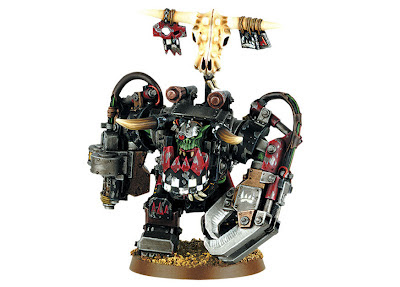
This is Ghazghkull Thraka according to current Warhammer 40,000 lore:
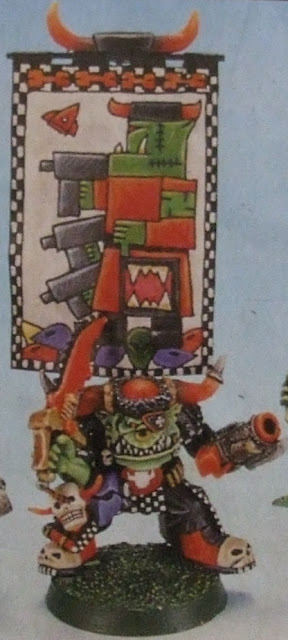
 But this is how he looked in first edition.
Now take a look at Generic Goff Warboss 1.
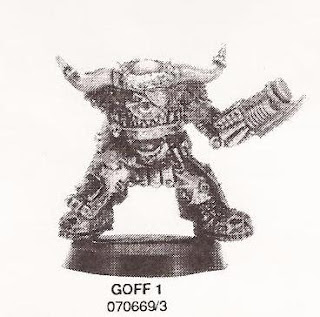
Ghazghkull is currently the Ork's foremost special character. Raised to the exalted rank of Warlord by virtue of a head injury that gave him an adamantium skull and a direct line to the Ork Gods of War. But Ghazghkull began life in White Dwarf 134 as the general of the studio's sample Ork army. Andy Chambers selected a warboss and randomly generated his equipment, including a roll on the painboy bionik bitz table. That meant rolling on a sub-table to determine which bit Ghazghkull had had replaced and then a second roll to see what special effect he picked up. This gave Ghazghkull a steel skull and a fearsome headbutt attack. But, because of the rules for head injuries, it also gave him a chance of re-awakening a dormant psychic power. Ghazghkull got lucky and picked up the Hammerhand power which gave him a close combat boost when successfully used.
Modern wargaming is often presented as a straight-forwardly competitive exercise. It's easy to forget the debt that Fantasy and Sci-Fi wargaming owes to Roleplaying games, which themselves grew out of historical wargaming. The first editions of Warhammer and Warhammer 40,000 started out more as combat heavy roleplaying experiences than battles between armies, for a start, both included Games Masters. Wargaming can be as much about story-telling as competition.
Truth may not be stranger than fiction, but sometimes random generation can lead to the creation of something you would never have invented from scratch. Some well placed random tables can do wonders to spark the imagination. More than that, a random army/warband requires you to work with what you're given, developing ideas and concepts around the resources provided rather than having a complete run of every troop type available.
There are a fair few wargames built around story-telling, particularly the GW specialist games, Mordheim, Blood Bowl and Necromunda, as well as Mongoose's Judge Dredd game. All of these have campaign gaming built in, the idea being to take a gang/squad/warband/team over a series of games. However, most of these give players total control. The only exception I can think of is Two Hour Wargames' Warrior Heroes - Armies and Adventures, a game which has more than a few things in common with Realms of Chaos. As well as being based on a randomly generated character and his followers, it's also not as tightly written as it could be and requires a fair bit of work by the player to get maximum value out of it.
WH:AA seems to be quite popular at the moment, with several blogs out there dedicated to the exploits of the random heroes, all of which focus on story-telling more than rules. Which tells me that there is an appetite out there for more story-focused gaming and, perhaps, it's time for a bit more randomness in wargaming.
Things start to get weird when you look at characters. There are no standard characters, only Chaos Champions all of which must be randomly generated. For 100 points you get a random base profile, d6 chaos rewards and d6 chaos attributes. Or you can roll on a random table of pre-generated champions. If you want a wizard, you'd better generate one. You can upgrade them, but this means more rolling. For 25 points you can roll on the steed table, for 25 more you can roll for a weapon. You might get a daemon weapon, but then you might get a club.
But this is in no way the maddest part. You can chose to make some or all of your army from randomly generated chaos warbands. These are generated in exactly the same way as a standard warband. Generate a champion, give him rewards and each reward gives you a chance of some followers. Slaves to Darkness makes some concession to reasonableness by requiring you to pay points for each roll, but the Lost and the Damned turfs this right out of the window in favour of having you choose an aspiring, mighty or exalted champion at 200, 400 or 800 points, giving you d4, d4+4 or d4+8 rewards. This, at least, means a mighty champion will definitely get more rolls than an aspiring one, but it still means you can pay 800 points for a human and 6 goblins or 200 for a dragon-ogre and has friends.
You can also included monsters if you want by, stunningly, rolling on a random table. If modern Games Workshop is all about using wargame rules to sell miniatures, old Games Workshop was about using wargame rules to sell dice.
There is absolutely no interest here in using points to create balanced and competitive armies. The only reason to use the points is to place something approaching a boundary on the army. For 3,000 points you get 1 exalted champion, 3 mighty champions and 5 aspiring. Get rid of the points and you'd be rolling forever.
It's easy to think of this obsession with d100 tables as specific to Realms of Chaos and, certainly, it's particularly prevalent here, but it does appear elsewhere. In the early days of Warhammer 40,000 Rogue Trader there were no army lists, forces were largely randomly generated and a Games Master was expected to devise scenarios. Conventional battles with army lists came quite a bit later. Though even these retained some of the random elements. The first Warhammer 40,000 Ork armies mostly used random equipment tables, you didn't pay points for a weapon you paid points for a roll on the weapon table.
Which brings us to Ghazghkull Thraka.
This is Ghazghkull Thraka according to current Warhammer 40,000 lore:


Now take a look at Generic Goff Warboss 1.

Ghazghkull is currently the Ork's foremost special character. Raised to the exalted rank of Warlord by virtue of a head injury that gave him an adamantium skull and a direct line to the Ork Gods of War. But Ghazghkull began life in White Dwarf 134 as the general of the studio's sample Ork army. Andy Chambers selected a warboss and randomly generated his equipment, including a roll on the painboy bionik bitz table. That meant rolling on a sub-table to determine which bit Ghazghkull had had replaced and then a second roll to see what special effect he picked up. This gave Ghazghkull a steel skull and a fearsome headbutt attack. But, because of the rules for head injuries, it also gave him a chance of re-awakening a dormant psychic power. Ghazghkull got lucky and picked up the Hammerhand power which gave him a close combat boost when successfully used.
Modern wargaming is often presented as a straight-forwardly competitive exercise. It's easy to forget the debt that Fantasy and Sci-Fi wargaming owes to Roleplaying games, which themselves grew out of historical wargaming. The first editions of Warhammer and Warhammer 40,000 started out more as combat heavy roleplaying experiences than battles between armies, for a start, both included Games Masters. Wargaming can be as much about story-telling as competition.
Truth may not be stranger than fiction, but sometimes random generation can lead to the creation of something you would never have invented from scratch. Some well placed random tables can do wonders to spark the imagination. More than that, a random army/warband requires you to work with what you're given, developing ideas and concepts around the resources provided rather than having a complete run of every troop type available.
There are a fair few wargames built around story-telling, particularly the GW specialist games, Mordheim, Blood Bowl and Necromunda, as well as Mongoose's Judge Dredd game. All of these have campaign gaming built in, the idea being to take a gang/squad/warband/team over a series of games. However, most of these give players total control. The only exception I can think of is Two Hour Wargames' Warrior Heroes - Armies and Adventures, a game which has more than a few things in common with Realms of Chaos. As well as being based on a randomly generated character and his followers, it's also not as tightly written as it could be and requires a fair bit of work by the player to get maximum value out of it.
WH:AA seems to be quite popular at the moment, with several blogs out there dedicated to the exploits of the random heroes, all of which focus on story-telling more than rules. Which tells me that there is an appetite out there for more story-focused gaming and, perhaps, it's time for a bit more randomness in wargaming.
Tuesday, 20 March 2012
The Joy of Simplicity
Last weekend MLB and I had plans to get in a game of Warhammer 8th edition. We wanted a rematch of the game between my Greenskins and his Ogres that we played at Christmas. Him to test out his 16th birthday present, the Blood Sail pirates, me to erase the stain on my honour caused by my previous ignominious defeat. In the end we found ourselves with less time than we had expected and the game was put on hold until Easter. Ultimately we ended up playing Dwarf King's Hold in front of the TV.
DKH is by no means as straightforward as Warpath and Kings of War, it has a few quirky features that take some getting used to, but it is in keeping with Mantic's preference for straightforward fuss-free game play.
There's no getting around the fact that we have a hobby with a complicated infrastructure. After the assembling, painting and scenery building there is the simple practical concern of setting up and putting away. I am one of the fortunate who can maintain a hobby room with a permanent gaming table. In my younger days getting in a game meant squeezing onto the dining room table, or clearing a substantial patch of floor. When you combine this with a less that straightforward set of rules, the game can start to feel more like work than fun.
This is why I question Games Workshop's choice to push bigger and bigger armies. It makes sense as a marketing strategy to get your players to buy as much as possible, but if the net effect is to make playing the game increasingly a chore, it can only be counter-productive in the long run.
Of course Mantic have also pushed the big army concept, but are at least attempting to marry it to a simpler, quicker, more straight-forward set of rules. But, as I wrote in my last post, one of the most refreshing things about Warpath was how quick it was to get through a game with the models in the box. MLB and I took no more than an hour. Double or triple the number of models and we are still talking about a game we can get through comfortably in an afternoon, even with setup and pack up time.
Rules complexity isn't solely about length. I wrote at length about the poor presentation of the Infinity rules, but once you get your head around the unusual turn structure it actually isn't that difficult to play. Though I would recommend producing a summary sheet with your models profiles for quick reference. What slows down Warhammer is the sheer number of special rules and exceptions of which you have to keep track.
I suspect part of the problem is trying to scale up a game that works better with smaller numbers. Warhammer 3rd edition has proven ideal for skirmish games between Chaos Warbands, but I expect it would be horribly cumbersome at the 3,000 point level recommended by Warhammer armies.
All of the above is really a round about way of saying that in my old age I increasingly appreciate simple and stream-lined rules. If nothing else, Mantic is good at providing a wargame experience with a minimum of fuss.
DKH is by no means as straightforward as Warpath and Kings of War, it has a few quirky features that take some getting used to, but it is in keeping with Mantic's preference for straightforward fuss-free game play.
There's no getting around the fact that we have a hobby with a complicated infrastructure. After the assembling, painting and scenery building there is the simple practical concern of setting up and putting away. I am one of the fortunate who can maintain a hobby room with a permanent gaming table. In my younger days getting in a game meant squeezing onto the dining room table, or clearing a substantial patch of floor. When you combine this with a less that straightforward set of rules, the game can start to feel more like work than fun.
This is why I question Games Workshop's choice to push bigger and bigger armies. It makes sense as a marketing strategy to get your players to buy as much as possible, but if the net effect is to make playing the game increasingly a chore, it can only be counter-productive in the long run.
Of course Mantic have also pushed the big army concept, but are at least attempting to marry it to a simpler, quicker, more straight-forward set of rules. But, as I wrote in my last post, one of the most refreshing things about Warpath was how quick it was to get through a game with the models in the box. MLB and I took no more than an hour. Double or triple the number of models and we are still talking about a game we can get through comfortably in an afternoon, even with setup and pack up time.
Rules complexity isn't solely about length. I wrote at length about the poor presentation of the Infinity rules, but once you get your head around the unusual turn structure it actually isn't that difficult to play. Though I would recommend producing a summary sheet with your models profiles for quick reference. What slows down Warhammer is the sheer number of special rules and exceptions of which you have to keep track.
I suspect part of the problem is trying to scale up a game that works better with smaller numbers. Warhammer 3rd edition has proven ideal for skirmish games between Chaos Warbands, but I expect it would be horribly cumbersome at the 3,000 point level recommended by Warhammer armies.
All of the above is really a round about way of saying that in my old age I increasingly appreciate simple and stream-lined rules. If nothing else, Mantic is good at providing a wargame experience with a minimum of fuss.
Monday, 12 March 2012
Warpath - First Try Out

The Obligatory box cover art shot
Last night, after some frantic last minute sticking earlier in the day, MLB and I played our first game of Warpath. We used the miniatures from the box and the sample scenario with a few bits and bobs of scenery dug out of my cupboard.
The focus of Warpath and Kings of War has been on simple rules that allow big battles with a minimum of fuss. But there is another side to that, playing small and medium sized battles extremely quickly. We got through the game in less than an hour and that included checking the rules a few times. The rules are basic, but flow very nicely and logically. We didn't come against any situation were the rules were less than clear or obvious or where different rules clashed.
The potential drawback is that it could become quite stale and repetitive with limited tactical options. I'm not sure yet. With the forces in the starter box, the Forge Fathers are heavily outnumbered, but have far superior long-ranged weaponry, while the Marauders have to use their numbers to weather the heavy fire and get into close combat where they will pretty much slaughter any of the Forge Father units. That could get repetitive very quickly, but I'm not sure how much some additional units will affect the game play.
MLB took the first game, losing two units of Marauder Grunts and his Raptor before ultimately slaughtering my Forge Fathers with his remaining two units. I think my mistake was in concentrating my fire on his damaged raptor and one grunt unit on turn two and leaving two more units unscathed.
This is the essential tactical dilemma of the game. Individual miniatures are not removed, instead each unit accumulates damage. At the end of the shooting and close combat phases units that have been damaged this turn must test their nerve, with a failed test suppressing or destroying the unit, depending on how badly it is failed. What this means is that no matter how effective your shooting you can't be sure of eliminating a unit until the end of the phase and you can always pile on more damage. I was concentrating fire to make certain that a unit would be removed, when I would probably have been better off spreading out fire and getting chance at removing several units. As it was, the two Grunt units that survived the game were completely unscathed.
If spreading you fire across multiple units is effective then it makes tactically advantageous to have lots of small units rather than a few big ones. Although smaller units can take less damage individually, you can spread their fire across multiple targets more effectively. Something to think about for the next game.
Warpath has been criticised for its simplicity, but I found a welcome lack of complication for the sake of it. There are games that are justifiably complicated, because they intend to simulate small actions in great detail, Infinity is a case in point. Warpath seeks to do the opposite, simulating larger actions in no more detail than is necessary. Whether it has the balance right is difficult to determine from one starter game, but so far, it feels refreshing not to get bogged down in detail.
It will take a few more games with a larger number of models to determine whether Warpath has the balance between detail and quick play right. But if you want a quick game with a minimum of fuss and bother it seems like a good system.
Tuesday, 6 March 2012
Warpath - Taking the Plunge
So I have finally taken the plunge and grabbed a copy of Fate of the Forgestar. Or, more accurately, split the cost and contents with MLB with him taking the Marauders and myself the Forge Fathers. I wrote a little while back that the contents of Warpath's starter box failed to inspire me, but a 40% reduction to £30 from Dark Sphere overcame that objection rather comfortably. Whether the reduction indicates the inevitable failure of the game, Mantic as a company and possibly the entire wargaming industry or whether Dark Sphere simply picked up a few too many starter boxes remains to be seen. But for £15, I felt it was worth a punt.

In terms of sheer numbers, MLB has done rather better than I have. He got 40 Marauders and a Raptor, for my 20 Forge Fathers and a Heavy Hailstorm cannon. That said, five of my twenty are veterans made from plastic-resin and in points terms we are pretty close to even. I have also benefitted from a bonus five forge fathers thrown in. Actually there are six, but as you can only use squads of five and there are only enough bases for five I give Mantic props for not advertising six.
The plastic troops are rather better than I expected. Much has been made of Mantic reusing their fantasy sculpts, but it works better than might be expected. In the case of the Forge Fathers its barely noticable, with only the backs and legs and optional heads coming straight from Kings of War. The legs integrate nicely with the stylised armour and the addition of some goggles take off the fantasy edge of the bonus heads. That said, that half the squad have cloaks is a little odd. They have also inherited a problem from the Fantasy dwarves, the pieces don't quite fit together properly meaning you either have to file down the backs or put up with a small gap between pieces.
The Marauders have proven a lot better than expected. It helps to see both types of sprue, the one with two bodies and the one with three. They are clearly intended to work in combination as the two body sprue comes with a number of spare heads, weapons and accessories that help customise the rest. With a little imagination and effort you can easily put together a good variety of decent looking poses.
As for the rest, the resin plastic is solid, free of flash and mold lines and sticks comfortably with super glue. On the down side, not all pieces fit together as well as I would like; the raptor is going to need some filing work and the veterans heat cannon cables do not in any sense join up with their back packs.
We haven't had a chance to try the rules yet (we only got them last Saturday) but they seem refreshingly straight forward. There is something rather appealing about the idea of a game we can get through in an hour or so without masses or page flipping and cross referencing. I am very much in favour of Mantic's commitment to getting everything into as few pages as possible. The presence of vehicles and multiple weapon types within a squad add a little complication over Kings of War, but nothing particularly confusing.
Also in Mantic's favour is the inclusion of a double sided scenario sheet designed to use the models in the box and with summary rules for all of them. Something that Games Workshop pointedly failed to include in Isle of Blood. The sheet does call the set Fate of the StarForge on a couple of ocassions and, less forgivably, fails to include the rules for the Anti-Tank gun on the Marauder Raptor, but, overall, it is a highly welcome inclusion and ensure that the set can function as complete game. That said, any truly new players are going to need to invest in some dice pretty soon, the box comes with ten but the Heavy Hail storm cannon alone rolls 16 for each shot. This is a definitely a "buckets of dice" game.
I am certainly looking forward to getting everything assembled and painted and giving it go. Is it worth fifty quid? Based on what I've seen so far, probably. Is it worth thirty? Most certainly.

A big stack of semi-assembled Mantic goodies
In terms of sheer numbers, MLB has done rather better than I have. He got 40 Marauders and a Raptor, for my 20 Forge Fathers and a Heavy Hailstorm cannon. That said, five of my twenty are veterans made from plastic-resin and in points terms we are pretty close to even. I have also benefitted from a bonus five forge fathers thrown in. Actually there are six, but as you can only use squads of five and there are only enough bases for five I give Mantic props for not advertising six.
The plastic troops are rather better than I expected. Much has been made of Mantic reusing their fantasy sculpts, but it works better than might be expected. In the case of the Forge Fathers its barely noticable, with only the backs and legs and optional heads coming straight from Kings of War. The legs integrate nicely with the stylised armour and the addition of some goggles take off the fantasy edge of the bonus heads. That said, that half the squad have cloaks is a little odd. They have also inherited a problem from the Fantasy dwarves, the pieces don't quite fit together properly meaning you either have to file down the backs or put up with a small gap between pieces.
The Marauders have proven a lot better than expected. It helps to see both types of sprue, the one with two bodies and the one with three. They are clearly intended to work in combination as the two body sprue comes with a number of spare heads, weapons and accessories that help customise the rest. With a little imagination and effort you can easily put together a good variety of decent looking poses.
As for the rest, the resin plastic is solid, free of flash and mold lines and sticks comfortably with super glue. On the down side, not all pieces fit together as well as I would like; the raptor is going to need some filing work and the veterans heat cannon cables do not in any sense join up with their back packs.
We haven't had a chance to try the rules yet (we only got them last Saturday) but they seem refreshingly straight forward. There is something rather appealing about the idea of a game we can get through in an hour or so without masses or page flipping and cross referencing. I am very much in favour of Mantic's commitment to getting everything into as few pages as possible. The presence of vehicles and multiple weapon types within a squad add a little complication over Kings of War, but nothing particularly confusing.
Also in Mantic's favour is the inclusion of a double sided scenario sheet designed to use the models in the box and with summary rules for all of them. Something that Games Workshop pointedly failed to include in Isle of Blood. The sheet does call the set Fate of the StarForge on a couple of ocassions and, less forgivably, fails to include the rules for the Anti-Tank gun on the Marauder Raptor, but, overall, it is a highly welcome inclusion and ensure that the set can function as complete game. That said, any truly new players are going to need to invest in some dice pretty soon, the box comes with ten but the Heavy Hail storm cannon alone rolls 16 for each shot. This is a definitely a "buckets of dice" game.
I am certainly looking forward to getting everything assembled and painted and giving it go. Is it worth fifty quid? Based on what I've seen so far, probably. Is it worth thirty? Most certainly.
Thursday, 9 February 2012
Expand or Die
Since the announcement, via video clip, that Privateer Press would be producing 'collosal' War Jacks for War Machine, opinion has been divided over whether this is an exciting new development or a evidence of the Games Workshop-isation of the Company. Sceptical voices have been making whispers of Apocalypse.
I don't feel particularly strongly either way, I have dabbled in War Machine and Hordes, but am not a heavy collector of either. However, the announcement is interesting to me because it says something about the nature and development of Fantasy wargames over time.
For some years now Games Workshop have been locked in an endless cycle of renewal, with new editions every five years or so and the refreshing of their armies in order to keep up momentum. They release the occasional genuinely new miniature, but the bulk of them are now new versions of existing miniatures. Their current goal seems to be to re-release as much as possible in plastic.
Since Third edition, each version of Warhammer has managed to reach a state of near completeness by the time its next edition is due. Which is to say that pretty much all the miniatures and army books have been available and there has been no strict requirement for GW to produce anything more. No edition has been perfect, but then no game is. The new editions are driven now by marketing concerns, the need to have something apparently new to sell each month.
This has generally been perceived as the behaviour of a cynical, greedy company artificially creating demand while steadily inflating its prices in order to exploit its customer base. Certainly Games Workshop has behaved badly enough over the years to justify much of the hostility towards them. However, I think there is more than a touch of desperation about their current position.
Wargames are like Empires: only strong while expanding. There is a constant need for new material, rules and miniatures to retain the interest of the customer base. That isn't to say there is no interest in older models, but a company that has nothing new to offer can all too easily drift off the radar.
When a game is first starting out there is an active need for new models and rules from both companies and players, but as the game ages additional material starts to become a barrier to entry. Privateer Press's approach has been to periodically produce new rulebooks with new rules for all its factions, but that meant by the end of first edition War Machine that a player needed to buy five rule books to get all the rules for the initial four factions.
New models can be similarly problematic. The more that are produced the more the initial enthusiasts can collect, but new players are faced with increasingly more choices and experienced opponents who have much larger armies. Meanwhile, it becomes more difficult for games shops to dedicate the space to display the full range. Plus there is the difficulty of coming up with a constant stream of new ideas.
In the face of this, wargame companies have essentially three options:
After Thirty years of Warhammer and twenty five of Warhammer 40,000 Games Workshop are trapped inexorably in stage 3, with new editions every few years that add less and less each time.
At the time I started out with Games Workshop, they were just starting to reach this point. Warhammer 40,000 was still developing in new and unexpected directions, but Warhammer was stagnant. A few new Chaos models appeared, but, essentially, the game and miniature range was complete. For the first two years after I started, essentially nothing new appeared for Warhammer and, at least among my friends, no-one paid it any attention to it at all. Then fourth edition appeared and interest picked up. Suddenly all my friends were collecting Warhammer armies, and every new army book prompted some-one to start a new army. Given the results it's hardly surprising GW have repeated the tactic.
I find the situation with Privateer Press intriguing because they have clearly tried option 3 recently with the new editions of War Machine and Hordes. but thanks to prompt and rapid army book releases have found themselves quite quickly back where they started. Now they seem to be trying tactic 1, keep producing new and exciting models and hope that new players are intrigued and not overwhelmed.
I am not making any judgement about either company, but it is fascinating to me that ultimately all successful wargames must end up in the same place.
I don't feel particularly strongly either way, I have dabbled in War Machine and Hordes, but am not a heavy collector of either. However, the announcement is interesting to me because it says something about the nature and development of Fantasy wargames over time.
For some years now Games Workshop have been locked in an endless cycle of renewal, with new editions every five years or so and the refreshing of their armies in order to keep up momentum. They release the occasional genuinely new miniature, but the bulk of them are now new versions of existing miniatures. Their current goal seems to be to re-release as much as possible in plastic.
Since Third edition, each version of Warhammer has managed to reach a state of near completeness by the time its next edition is due. Which is to say that pretty much all the miniatures and army books have been available and there has been no strict requirement for GW to produce anything more. No edition has been perfect, but then no game is. The new editions are driven now by marketing concerns, the need to have something apparently new to sell each month.
This has generally been perceived as the behaviour of a cynical, greedy company artificially creating demand while steadily inflating its prices in order to exploit its customer base. Certainly Games Workshop has behaved badly enough over the years to justify much of the hostility towards them. However, I think there is more than a touch of desperation about their current position.
Wargames are like Empires: only strong while expanding. There is a constant need for new material, rules and miniatures to retain the interest of the customer base. That isn't to say there is no interest in older models, but a company that has nothing new to offer can all too easily drift off the radar.
When a game is first starting out there is an active need for new models and rules from both companies and players, but as the game ages additional material starts to become a barrier to entry. Privateer Press's approach has been to periodically produce new rulebooks with new rules for all its factions, but that meant by the end of first edition War Machine that a player needed to buy five rule books to get all the rules for the initial four factions.
New models can be similarly problematic. The more that are produced the more the initial enthusiasts can collect, but new players are faced with increasingly more choices and experienced opponents who have much larger armies. Meanwhile, it becomes more difficult for games shops to dedicate the space to display the full range. Plus there is the difficulty of coming up with a constant stream of new ideas.
In the face of this, wargame companies have essentially three options:
- Soldier on regardless, producing more and rules and models and risk putting off potential new players.
- Sweep everything clean, starting over or focusing on a new game, and alienate existing player.
- Something of a fudge, release a new edition tweaking some of the rules problems that have been discovered and produce new, hopefully better, versions of existing models.
After Thirty years of Warhammer and twenty five of Warhammer 40,000 Games Workshop are trapped inexorably in stage 3, with new editions every few years that add less and less each time.
At the time I started out with Games Workshop, they were just starting to reach this point. Warhammer 40,000 was still developing in new and unexpected directions, but Warhammer was stagnant. A few new Chaos models appeared, but, essentially, the game and miniature range was complete. For the first two years after I started, essentially nothing new appeared for Warhammer and, at least among my friends, no-one paid it any attention to it at all. Then fourth edition appeared and interest picked up. Suddenly all my friends were collecting Warhammer armies, and every new army book prompted some-one to start a new army. Given the results it's hardly surprising GW have repeated the tactic.
I find the situation with Privateer Press intriguing because they have clearly tried option 3 recently with the new editions of War Machine and Hordes. but thanks to prompt and rapid army book releases have found themselves quite quickly back where they started. Now they seem to be trying tactic 1, keep producing new and exciting models and hope that new players are intrigued and not overwhelmed.
I am not making any judgement about either company, but it is fascinating to me that ultimately all successful wargames must end up in the same place.
Monday, 30 January 2012
Re-forging the Ring - Updated
After a period of rumours, the news is officially out that Games Workshop is re-releasing its Lord of the Rings Strategy Battle Game. With the Hobbit movies on the way that this would happen sooner or later is hardly surprising, though GW's rapid move suggests they want everything sorted out and in place well before the official Hobbit miniatures are due for release.
One interesting shift is that War of the Ring is, apparently, to be more or less dropped from sale. Shuffled off into the Specialist games hinterland with the focus on the old Strategy Battle Game. Presumably GW have concluded that it has run its course, whether that means it failed or simply that they had gotten as much out of it as they could is less certain.
The Lord of the Rings Strategy Battle Game has actually been a remarkably stable rule set by wargaming standards, let alone GW's. Technically it is still on its First edition. Although three rule books were released in quick succession, one for each movie, these were really just expansions of the original rules rather than new editions. The current rulebook essentially consolidated the same rules with only a few small tweaks, has been around for seven years and is not due to be replaced now. As far as I am concerned this is very much a good thing as the essential rules work well at what they are designed to do and don't need re-writing for the sake of it.
That said, I am much less enamoured of the new that the current run of source books is due to be droppped, with the exception of the Lord of the Rings Journey books, and replaced with five "army books" covering the major forces of Middle Earth. I am sure some people will welcome the news, particularly Rohan or Isengard players who have been left without a dedicated supplement since the release of the new edition. And the existing books are hardly a coherent collection, some focus on regions, others on conflicts and some on armies or races.
However, the move to, what sounds like, a more Warhammer/Warhammer 40,000 model of army books, albeit ones that cover more than one army list, is, I think, unfortunate and threatens to undermine some of the unique characteristics of Lord of the Rings as a game in contrast to its Warhammer counterparts.
As a relatively rare licensed war game, LOTR is set in a world that was not created to be a wargaming back drop. It is not a world of eternal warfare in which neatly defined races, each with their own distinct armies can be neatly picked out and pitted against one another. The story of Middle Earth is one of intermitant warfare, punctuated by conflicts between specific forces and nations. What that means is that certain combinations of armies never fought one another and others fought only briefly. The full army of Isengard, for example, was only ever employed in one battle, Helm's Deep.
Of course some players, quite reasonably, ignore this. They take their favourite armies and fight against one another without consideration for the background or history that inspired them. And their is absolutely nothing wrong with that. However, others, including myself, prefer their games to be grounded in the setting, preferring to play games that recreate battles that Tolkein described, or ones consistent with the world he created.
In some senses LOTR is actually more like an historical wargame than a fantasy one. Like an historical game it attempts to reflect defined conflicts that were defined outside of the company producing the game without consideration for its use as a game. Both use a wide variety of army lists, many of which blur together, covering a long period of history. Also, as with some historical armies, some LOTR armies are drawn very firmly from the source material, while others are more speculative, based on only partial accounts.
The other feature that sets LOTR apart from Games Workshop's other games was that it was designed specifically to support scenario-based gaming with heavly unbalanced forces. The Hero rules were written so that namd characters would behave quite differently from regular troops and that the most powerful characters from the books, Gandalf, Aragorn etc, could fight single-handedly against a horde of nameless enemies. In that sense, LOTR is entirely unlike an historical game.
The three supplements that most supported this approach, and which are, thankfully, still being kept in print, are the three Journey books that cover the three volumes of the Lord of the Rings. The Fellowship of the Ring supplement, in particular, is one of my favourite gaming supplements, because it combines rules, scenarios and scenery building workshops and presents them in the order that they are needed. This means it is possible to work your way through the book from start to finish preparing models and scenery as you need them for the scenarios. Of course some compromises have to be made to suit the narrative of the source material. So it is necessary to tackle the comples Weathertop project quite early on.
Sadly, Games Workshop quickly abandoned this approach with their supplements not based directly on the books. After Fall of the Necromancer scenery building ws dropped and scenarios became less and less important. By the time of the Mordor supplement, Games Workshop had even abandoned location or conflict based supplements, creating what was, in effect, an army book.
And sadly, that is where we find ourselves now. Five supplements books are to be released covering the different LOTR armies. These are themed not by conflict, narrative or location, but simply by sticking the armies that seem most similar together. So we have one for Men, one for Elves, Dwarves and Hobbits, one for Mordor, one for Moria and Angmar and one for all the other evil armies (or the fallen realms, as they are calling them). The design of these books is looking less than inspiring, with single stills from the Movies on standard blue covers. They will, at least, contain scenarios, but it is hard to escape the feeling that this is an attempt to produce Warhammer style army books to allow gamers to pick armies to agreed points values and with only a limited interest in the Middle-Earth back drop.
I can't help but feel that this is another missed opportunity from a company unwilling to be creative or take risks any more. Despite War of the Ring not proving successful enough to keep going as a mainstream game, Games Workshop still seem determined to Warhmmer-ise LOTR. This requires them to play down all the elements that make it distinct from Warhammer, a setting not designed for Wargaming, unbalanced narrative scenarios, a strong role for heroic characters and a game that could be played very comfortably at a number of scales.
Time will tell whether this move proves to be a success or not, but, personally, far from rekindling an interest in the game, all they have managed to do is put me off it.
Update
Since writing the above, Games Workshop have released some more information about the new books on their blog.
I'm not very reassured by this. The scenarios are welcome, but the examples they cite are either generic or essentially re-prints. The new army list format also seems to add an unneeded layer of complication to what was a very simple system. It is now a requirement to include one hero for every 0-12 regular fighters. It isn't a major restriction, but it does feel unnecessary. Why add a restriction where none is needed?
One interesting shift is that War of the Ring is, apparently, to be more or less dropped from sale. Shuffled off into the Specialist games hinterland with the focus on the old Strategy Battle Game. Presumably GW have concluded that it has run its course, whether that means it failed or simply that they had gotten as much out of it as they could is less certain.
The Lord of the Rings Strategy Battle Game has actually been a remarkably stable rule set by wargaming standards, let alone GW's. Technically it is still on its First edition. Although three rule books were released in quick succession, one for each movie, these were really just expansions of the original rules rather than new editions. The current rulebook essentially consolidated the same rules with only a few small tweaks, has been around for seven years and is not due to be replaced now. As far as I am concerned this is very much a good thing as the essential rules work well at what they are designed to do and don't need re-writing for the sake of it.
That said, I am much less enamoured of the new that the current run of source books is due to be droppped, with the exception of the Lord of the Rings Journey books, and replaced with five "army books" covering the major forces of Middle Earth. I am sure some people will welcome the news, particularly Rohan or Isengard players who have been left without a dedicated supplement since the release of the new edition. And the existing books are hardly a coherent collection, some focus on regions, others on conflicts and some on armies or races.
However, the move to, what sounds like, a more Warhammer/Warhammer 40,000 model of army books, albeit ones that cover more than one army list, is, I think, unfortunate and threatens to undermine some of the unique characteristics of Lord of the Rings as a game in contrast to its Warhammer counterparts.
As a relatively rare licensed war game, LOTR is set in a world that was not created to be a wargaming back drop. It is not a world of eternal warfare in which neatly defined races, each with their own distinct armies can be neatly picked out and pitted against one another. The story of Middle Earth is one of intermitant warfare, punctuated by conflicts between specific forces and nations. What that means is that certain combinations of armies never fought one another and others fought only briefly. The full army of Isengard, for example, was only ever employed in one battle, Helm's Deep.
Of course some players, quite reasonably, ignore this. They take their favourite armies and fight against one another without consideration for the background or history that inspired them. And their is absolutely nothing wrong with that. However, others, including myself, prefer their games to be grounded in the setting, preferring to play games that recreate battles that Tolkein described, or ones consistent with the world he created.
In some senses LOTR is actually more like an historical wargame than a fantasy one. Like an historical game it attempts to reflect defined conflicts that were defined outside of the company producing the game without consideration for its use as a game. Both use a wide variety of army lists, many of which blur together, covering a long period of history. Also, as with some historical armies, some LOTR armies are drawn very firmly from the source material, while others are more speculative, based on only partial accounts.
The other feature that sets LOTR apart from Games Workshop's other games was that it was designed specifically to support scenario-based gaming with heavly unbalanced forces. The Hero rules were written so that namd characters would behave quite differently from regular troops and that the most powerful characters from the books, Gandalf, Aragorn etc, could fight single-handedly against a horde of nameless enemies. In that sense, LOTR is entirely unlike an historical game.
The three supplements that most supported this approach, and which are, thankfully, still being kept in print, are the three Journey books that cover the three volumes of the Lord of the Rings. The Fellowship of the Ring supplement, in particular, is one of my favourite gaming supplements, because it combines rules, scenarios and scenery building workshops and presents them in the order that they are needed. This means it is possible to work your way through the book from start to finish preparing models and scenery as you need them for the scenarios. Of course some compromises have to be made to suit the narrative of the source material. So it is necessary to tackle the comples Weathertop project quite early on.
Sadly, Games Workshop quickly abandoned this approach with their supplements not based directly on the books. After Fall of the Necromancer scenery building ws dropped and scenarios became less and less important. By the time of the Mordor supplement, Games Workshop had even abandoned location or conflict based supplements, creating what was, in effect, an army book.
And sadly, that is where we find ourselves now. Five supplements books are to be released covering the different LOTR armies. These are themed not by conflict, narrative or location, but simply by sticking the armies that seem most similar together. So we have one for Men, one for Elves, Dwarves and Hobbits, one for Mordor, one for Moria and Angmar and one for all the other evil armies (or the fallen realms, as they are calling them). The design of these books is looking less than inspiring, with single stills from the Movies on standard blue covers. They will, at least, contain scenarios, but it is hard to escape the feeling that this is an attempt to produce Warhammer style army books to allow gamers to pick armies to agreed points values and with only a limited interest in the Middle-Earth back drop.
I can't help but feel that this is another missed opportunity from a company unwilling to be creative or take risks any more. Despite War of the Ring not proving successful enough to keep going as a mainstream game, Games Workshop still seem determined to Warhmmer-ise LOTR. This requires them to play down all the elements that make it distinct from Warhammer, a setting not designed for Wargaming, unbalanced narrative scenarios, a strong role for heroic characters and a game that could be played very comfortably at a number of scales.
Time will tell whether this move proves to be a success or not, but, personally, far from rekindling an interest in the game, all they have managed to do is put me off it.
Update
Since writing the above, Games Workshop have released some more information about the new books on their blog.
I'm not very reassured by this. The scenarios are welcome, but the examples they cite are either generic or essentially re-prints. The new army list format also seems to add an unneeded layer of complication to what was a very simple system. It is now a requirement to include one hero for every 0-12 regular fighters. It isn't a major restriction, but it does feel unnecessary. Why add a restriction where none is needed?
Subscribe to:
Posts (Atom)