Saturday, 7 September 2013

Kings of War Kickstarter - the end and a review

My final Mantic Games Kings of War Kickstarter box has arrived, leaving me in a position to evaluate the campaign as a whole. I haven't opened everything or assembled anything yet so I am in a better position to judge some things rather than better than others, but my current position is summarised below.

Very Good
Gargoyles
Trolls (I know some people don't like the stumpy legs, but I like my Trolls to look odd an misshapen)
Ogres
Obsidian Golems
Goblin Mincer
The heroes, with one notable exception
Goblin Fleabag Riders


Good
Elf Palace Guard
Mummies
Cat Cavalry
Abyssal Dwarf Infernal Guard
Orc Chariot/Fight Wagon
Werewolves (Unfairly maligned, in my opinion. Probably because of the sample paint job in which the furry areas and fleshy areas are painted in different colours. Painted in one unified colour they look much better)

Okay
Mounted Paladins
Foot Paladins

Flawed
Battle Sisters
Mikayel (Twighlight Kin Hero)

Is that supposed to be a rocking horse?

Um...
Men at Arms

Reserving Judgement (Mantic haven't put out any pictures of these yet and they come in too many pieces to easily evaluate)
Dwarf Badger Riders
Elf Cavalry
Twilight Kin Cavalry

The Basilean Men-At-Arms are not good, to put it mildly. There's been a lot of criticism of the faces, which look a bit wrong, but to my eye they just look ugly. That's not necessarily a problem, in an army full of shining paladins, warrior nuns and angels, making the rank and file look a bit lumpen seems fair enough.

But there's a lot more wrong, both in sculpting and production. The arms and legs look too long for the bodies. On the face of it this is a sculpting problem, but it could be that they were sculpted for resin plastic, which shrinks a lot more in production than hard plastic. If that's the case, the conversion process for hard plastic hasn't been done very well. Then there's the plastic itself, which looks cheap and shiny and tends to obscure detail, particularly on the chainmail. And then there's hands and weapons are separate components, which means they don't look like they have a proper grip on their weapons. On the positive side, the weapons are very nice pieces that will be useful as spare parts.

Beyond sculpting and production, there seem have been problems at the concept stage. We get five bodies, one running, two advancing, one standing and fighting and one stock still. This makes it impossible to assemble a single box into a regiment that looks coherent. Mantic haven't bothered, their sample units use either the standing and advancing or the fighting and running bodies. Also, other than the weapons, we get no spare parts. There's enough for five models with nothing left over, which, frankly, feels a bit stingy.

The final, and most egregious, problem is that they're just too big. They stand taller than Games Workshop's Empire soldiers, while most of Mantic's models are smaller and less 'heroically' scaled.

Compared to Mantic's early plastics these are very poor. There earliest, the Elves and Skeltons combined good detail, casting and a wealth of extra pieces. They weren't quite at Games Workshop's standards but more than justified the price. Later sets, the Dwarfs and Orcs reduced the number of figures and parts, but were still well cast. The casting quality of the goblins is, to be generous, variable (and to be less generous, crap), but at least the sculpting was good.

Until the goblins, Mantic always used Renedra. I'm not sure why they stopped, if it was an issue of cost, time, Renedra are, apparently, snowed under with work from Warlord, Perry and Gripping Beast among others and responsible for much of the wargaming industries non-Games Workshop plastic, or something else. But Mantic's post-Renedra efforts haven't been promising, and leave me slightly worried about Deadzone and its plastic buildings. I don't blame Mantic for sending a team out to China.

Mantic do seem to have noticed the problems, even if they're are not quite acknowledging them openly. The final overview update to the Kickstarter from Ronnie Renton includes this rather telling paragraph:
We used a new process from the one with which we made Goblin plastic sprue, and I think the Men at arms are a big step up in quality from those. While I think they meet the reasonable price for a good number of army figures, I am still not happy that these are at the level I want to see our hard plastic figures. We are still working on this. Until we can find a method that takes the details back to those we have had in the past we will not stop. Every time we learn more and we get better, but we are not there yet, and I thank you for your patience.
Translated from marketing speak, I think that reads "our Men-at-Arms were crap, we don't want to make that mistake again."

Given that Mantic started off trying to compete with Games Workshop producing hard plastic, fantasy miniatures, it's troubling that this is the area where they appear to be struggling. On the plus side, the resin-plastic models have generally improved over time and their prices still give Games Workshop a run for their money, particularly when you take advantage of the larger horde and army boxes.

Moving rapidly to a tangent, this is the first Kickstarter I have seen through to the end, so what can we learn about Kickstarter (and crowd-funding in general) from it?

I have written before about how the relationship between wargames companies and their customers can be weirdly personal and how this can be both a blessing and a curse for both parties. Kickstarter intensifies this relationship.

Backers or Pledgers (not customers note) have to offer money for a product largely sight unseen, which may never be delivered based, substantially, on the company's prior reputation. In return they get a bundle of freebies, exclusives, the promise of getting things before anyone else and a sense of personal involvement with the company thanks to some direct communication. Mantic, in particular, have been very good at communication, responding to comments and incorporating requests into their plan.

The drawback is the sense of entitlement this breeds. Pledgers feel special and that means they expect special treatment and woe betide the company that does something to upset that. Delays rapidly lead to grumbling and Mantic found themselves the subject of serious hostility with their Dreadball Kickstarter when a few copies of the game found their way into the shops before all pledgers had gotten their copies.

Speaking of delays, the other problem with Kickstarter seems to be an obsession with delivery dates. Much of the complaints surrounding Kickstarter in general relate to delays and slipped delivery dates. It's not surprising, Kickstarter already feels less real and concrete than a proper purchase and it feels like a short step from delayed shipment to no shipment to company skipped town with all your money. The consequence is that many companies are obsessed with not missing their deadlines.

Ronnie Renton referred to CNN's article listing Mantic as a successful Kickstarter as a proud moment. But it's significant that this article is all about delivering on time. Part of Mantic's delivery slipped back to August and they felt the need to add extra models to the earlier shipment by way of compensation.

If you look at my list above, its worth noting that its the Bassileans who are slipping into the Okay and Flawed categories and the worst of the bunch is also Bassilean. I wonder if this was because they were rushed out to meet a deadline and suffered as a consequence. The men-at-arms really aren't good enough and, given more time, might Mantic have gone back to the drawing board? I don't know, but I can't imagine rushing is good for the models or for customer satisfaction.

As crowd funding matures, and feels a bit less ephemeral, maybe the focus will shift. Backers may stop worrying about whether their rewards will show up at all, and more about what  state their in when they arrive.

On the other hand, given how strongly gamers can feel about games companies, and given how a Kickstarter tends to intensify those feelings, if gamers find more to complain about than just delivery dates, we could end up with a very bitter and angry community.

Monday, 2 September 2013

Great Battle or Great Game?

At the Battle of Cannae, the Carthaginian general Hannibal (the guy with the Elephants) successfully defeated a numerically superior Roman army, by spreading out his line and attacking both flanks of the Roman army, enveloping it and restricting its ability to bring its number to bear.

It is regarded as one of the greatest tactical feats of antiquity and one of the greatest defeats of Rome. In fact, the defeat was so total that the Romans refused to engage him in open battle again. Forcing Hannibal into siege warfare for which he was ill-equipped.

So, if you wanted to wargame this battle how would you go about it?

The problem is that, at the time, Hannibal's tactics were unexpected. The Roman commander Varro, was impatient and arrogant, engaged too quickly and fell into Hannibal's trap. But a modern wargamer knows exactly what to expect from the Carthaginians, and wouldn't be stupid enough to let history repeat itself.

You could introduce rules requiring the Romans to deploy and engage as they did historically. Or at least to limit the tactical options. But then why re-fight the battle if both sides are forced into repeating the same behaviour.

Alternatively, both sides could be allowed to deploy and engage freely. But this puts the Carthaginian player at a significant disadvantage. One of the reasons Hannibal's triumph is so famous is that it was an against-the-odds victory against a numerically superior foe. Unfortunately, most wargamers are not Hannibal.

The above illustrates the difficulty of reworking historical battles into wargame scenarios. Many a great battle was won because of incompetence of one side, the extreme skill of another or just plain luck. All elements that are hard to rework into an interesting game for both sides (I don't think anyone's in favour of pitching incompetent players against skilled ones just for a laugh).

One interesting approach, might be to let a games master run the scenario, without the players knowing which battle they are re-fighting. Hand both players the resources of the generals and see how it develops. Of course, this doesn't help to resolve imbalances, like the Romans greater numbers at Cannae.

In the end, not all great battles make for great games.

Friday, 30 August 2013

The Next Generation

Readers of this blog based in the UK may have been aware of a publication called CLiNT, if only because it could be found within glancing distance of the wargames magazines in most branches of WH Smith. It was an anthology comic, edited by Mark Millar creator of Kick-Ass, among other things, which attempted to see if there was space in the UK comic market for something other than kid's fair that relied on free gifts to generate sales and 2000AD. Apparently, the experiment was a failure, as CLiNT has published its last issue.

Judging by the mix of extreme violence, moodiness and a slightly odd focus on celebrities (not to mention the 'hilarious' joke title which looks a bit rude if you read it from a long way away), I suspect CLiNT's target audience may have been teenagers whose parents didn't know what they were reading. Not that there's anything much wrong with that. Rebelling against parental authority is an important part of being a teenager and better they do through reading a slightly unsuitable comic than through petty crime. But, it seems the target audience weren't all that interested.

Since at least the 1990s  the audience for comics has been ageing, as dedicated fans largely stick with the industry but are not supplemented by younger readers. It's a phenomenon not unique to the comics industry. Some time back I speculated that traditional wargaming might suffer in the face of a generation who had a less tactile and more virtual connection with their hobbies and interests. The wargaming industry could find itself in the same boat as the comic industry.

Oddly, this is one area where Games Workshop seem to have the right attitude. Whatever you might say against them (and I have said plenty), their focus on younger players, and refusal to rely on the loyalty of existing customers, has got to be the right approach. Whether this strategy can be maintained in the face of regular above inflation price rises, when the cost of living is rising and wages stagnating, is more questionable. So, points for intent, if not for execution

But what of the rest of the Industry. I have to admit, that the approach sometimes looks like naval gazing. Much of the marketing for wargame products is focused on wargame websites and magazines, while a significant portion of the industry is focused on producing material of interest to existing wargamers. There are times when it appears to be doing what the smoking industry claimed to be doing for years, trying to persuade existing customers to "switch brands."

On the other hand, I'm not sure what else they should be doing. My own introduction to wargaming came via the brother of a friend and, having discovered that Games Workshop existed and what it was, I tracked down White Dwarf. Today, I would probably have googled it, but the scenario would have been much the same. The industry has no trouble providing information for interested newbies, in fact its far better than when I started out, the problem is generating the interest in the first place. I wonder how many wargamers started out in much the same way I did, through friends or elder brothers (or sisters) and how dependent the industry is on word of mouth.

I'm afraid this isn't a post that provides a lot of answers, only asks a lot of questions. But if the wargaming industry is to survive long term it needs to continuously engage with a new generation of customers, and I worry that the company most keen to do so may be the least capable of doing so.

Monday, 19 August 2013

Status Report

Hello out there. I'm sorry this blog has been somewhat neglected of late. I would like to offer some interesting and impressive excuse, but the honest truth is that I've been struggling for things to write about.

Part of the problem has been my 'one project at a time' philosophy. It served me pretty well in getting my Chaos Dwarfs up and running, but my latest project isn't actually wargame related, so the net result is that I haven't been doing a lot of painting, modelling or gaming. Following on from that, I haven't been thinking about it as much either. Usually, painting and gaming gets me thinking about things, which leads to blog post ideas. Or at very least some things I can photograph and show off.

But we may have turned the corner. My latest, non-wargaming project, is nearly at an end, which means back to painting and, hopefully, that will get the creative juices flowing again.

Monday, 15 July 2013

Do we need games magazines anymore?

Jake Thornton has posted the Beta rules for the latest three Dreadball teams on the Quirkworthy blog. Once, long ago, these would have been published in a printed magazine. That they now appear on the games designers blog highlights one more area once occupied by dead tree publications that has been annexed by the web.

With the Internet all but ubiquitous, there is really very little left for gaming magazines. Experimental rules work better on the Internet because the designer can get immediate feedback and make quick updates. News is also better managed by websites and blogs which can update more frequently and post corrections.

Other traditional areas covered by magazines, from painting advice, modelling guides, reviews, battle reports may not be any better online, but they certainly aren't any worse and have the advantage of costing far less to publish. It feels like the only advantage print has is that it can be carried to the gaming table, but in the era of Ipads, Tablets and smart phones even that advantage is falling away.

Looking back ten years or more, most miniature companies looking to make a name for themselves, or just compete with Games Workshop, felt the need for some kind of house journal or periodical, from Cry Havoc (Rackham) to No Quarter (Privateer Press). Mantic Games tried it for a little while, but dropped the idea quite quickly. Wyrd Games produce a digital magazine, before focusing their attention on the website. And Cipher Studios have run their blog as a kind of rolling online magazine.

So it feels like the era of the printed games magazine is ending. Does it really matter? Have we not replaced one way of distributing content with another, better, system? Well there is one respect in which a magazine can be better than the web. The web offers an article, blog or video for everyone on almost any subject imaginable. But it is so vast, that you have to go and look for it. A good magazine can offer a selection of articles on a variety of subjects, some of which you might not have thought to read. I have started more than one army and more than one game simply because of a sideways glance at an article in a magazine I had bought for a completely different reason. Yes it is possible to stumble across interesting and unexpected content on the Internet, but are you as likely to?

So if the printed magazine is becoming a thing of the past, there is at least one area where we may be worse off.

Friday, 5 July 2013

A big ol' box of fun

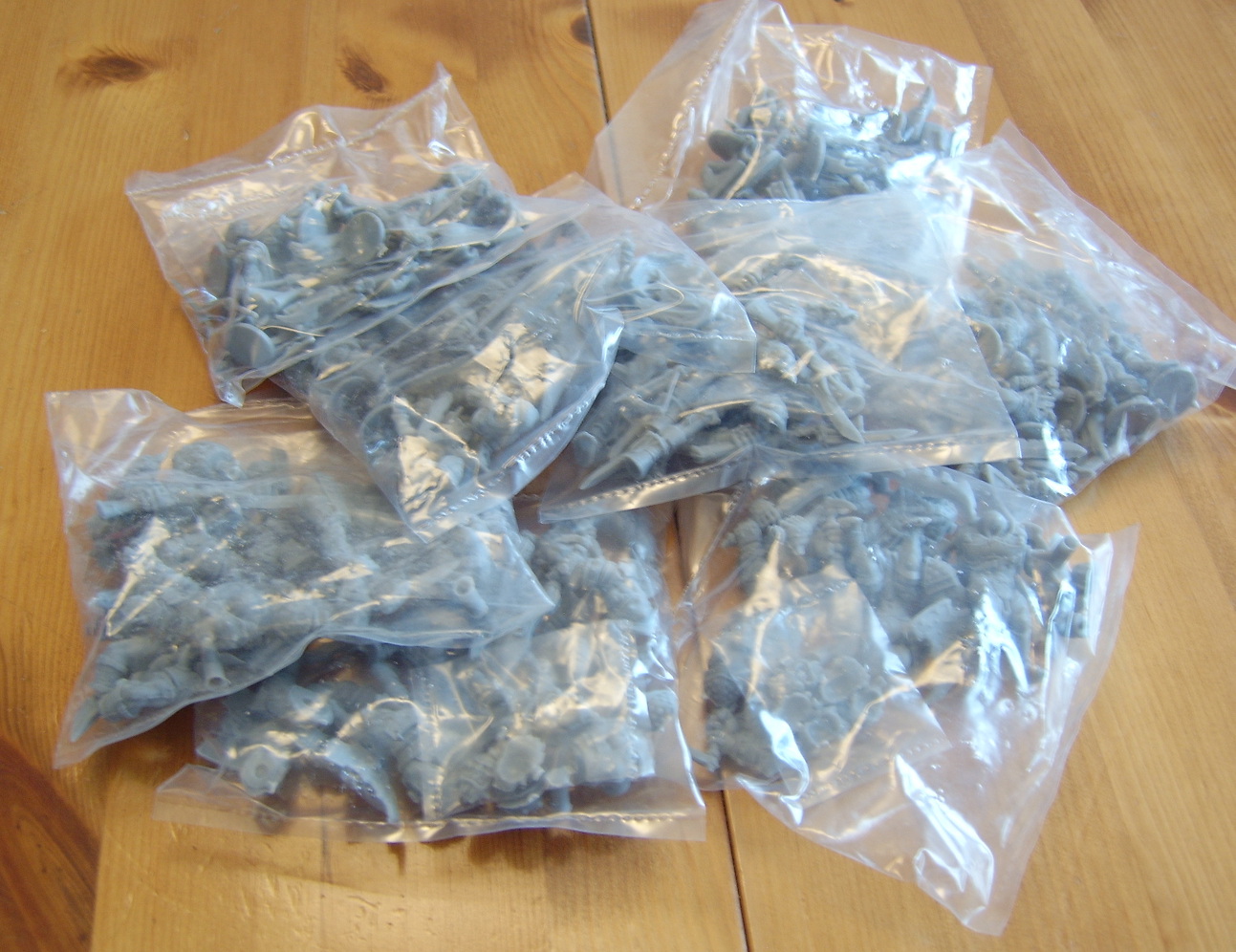
Look what I found waiting for me when I got home from work yesterday.


It's my second reward bundle from Mantic's Kings of War Kickstarter, including a good sample selection of all the KOW models Mantic have up for pre-order at the moment. I knew that they had posted these out at the weekend, but it always feels good to come home to a parcel of goodies.


As my original pledge was worth $175 I knew I would be getting a good selection of free samples. I had also ordered some Ogres, to add to my historical Normans to make them a bit more fantasy for KOW, some Mummies for my Undead and some Elf Palace Guard for MLB (for which he will be compensating me). What I hadn't expected was for Mantic to add this on to my original pledge total meaning that I beat the $225 limit for the next batch of freebies. So I ended up with 3 extra Ogres, 3 werewolves and a goblin mincer I wasn't expecting. Plus there's more to come.

 Basic freebie bundle

There have been some delays, so the Elf cavalry, Abyssal Dwarf Immortal Guard, Gargoyles and most of the Basilean humans (Battle Nuns, Cat-riders and Angels mostly) aren't going to be here for another month or two. But, by way of compensation, Mantic have doubled up my goblin fleabag-riders and Dwarf Brock-riders, so I ended up with ten of each. The dwarves are certainly welcome.

 Extra stuff I paid for

I have only glanced over the models so far and haven't opened or glue anything together yet, but everything seems to be pretty well cast, though there are some frighteningly tiny components.

 Bonus freebies

Now that I have the rather lovely new trolls, the Fight Wagon and the Orc Wizard from the previous bundle of goodies I am seriously thinking about a KOW Orc army. I am sure this is all part of the plan. Nothing like a big bundle of freebies to get you to spend lots more money.

 Lady Ilona the Vampire

Wednesday, 3 July 2013

Double Duty

Do you use the same miniatures for more than one game?

Obviously there are some companies who have actively used a range of miniatures as for more than one game. Rackham did it with Confrontation and Ragnarok, Games Workshop with Mordheim and Warhammer and soon Mantic with Deadzone and Warpath, to name but three. Not to mention the venerable history of borrowing models from a tabletop army to use in a Dungeon Crawl board game (Advanced HeroQuest, Warhammer Quest, Dwarf King's hold and so on).

But what about using the same, or almost the same, army for two different table top games. Mantic started out making models that were blatantly usable in Warhammer and Avatars of War have done the same, but now they have their own games would you still use the models for Warhammer?

I have to admit I have always felt a bit funny about this. I can't pretend its rational, but somehow I feel as though each army should be tailored for a particular fantasy world. I don't like the idea that my Mantic Undead should have a kind of cross dimensional existence in both the Warhammer and Mantic worlds. Weirdly, the rule even applies to games that aren't associated with a particular range of miniatures. I have been looking at Song of Blades and Heroes lately, but even there I think I would have to use a specific set of models for the game. It makes no sense, and its costing me money and shelf space.

Strangely, this self-imposed rule doesn't apply, or at least doesn't apply as strongly, to historical games. I have now issue with the idea of using my Normans and Saxons for Clash of Empires or Hail Caesar, or my (very slowly) developing Samurai army for Taiko or Osprey's forthcoming Ronin. Maybe, because historical miniatures represent actual people, they cannot be coupled to a rules set in the way that an invented fantasy or sci-fi range can?

Maybe there's hope for me in this direction. Just recently, I tried playing Kings of War using my Normans as a human kingdom, and now I have ordered a bunch of Mantic's Ogres to bulk them out in fantasy gaming only. The big test will be if I ever use them for Warhammer.