Wednesday, 13 February 2013

White Dwarf 181

It has been far too long since I did one of these and they have been far too infrequent. Time to rectify that I think.


White Dwarf 181 is here and for the first time we have skipped a decade, the 170s brought with them Warhammer Armies Chaos, Warhammer 40,000 Eldar and Orks, Blood Bowl 3rd edition and, just about, Titan Legions.

If White Dwarf 169 was keen to demonstrate that it was now in full colour, White Dwarf 181 takes it to even greater extremes. Even the black and white line art lifted from army books has been a splash of colour while every heading is coloured, bold or bordered and big pictures, mostly of models, but also of studio and WD staff abound. That we are now slap bang in the middle of the infamous "red period" is all too apparent. Taste and subtlety have been tossed out of the window.
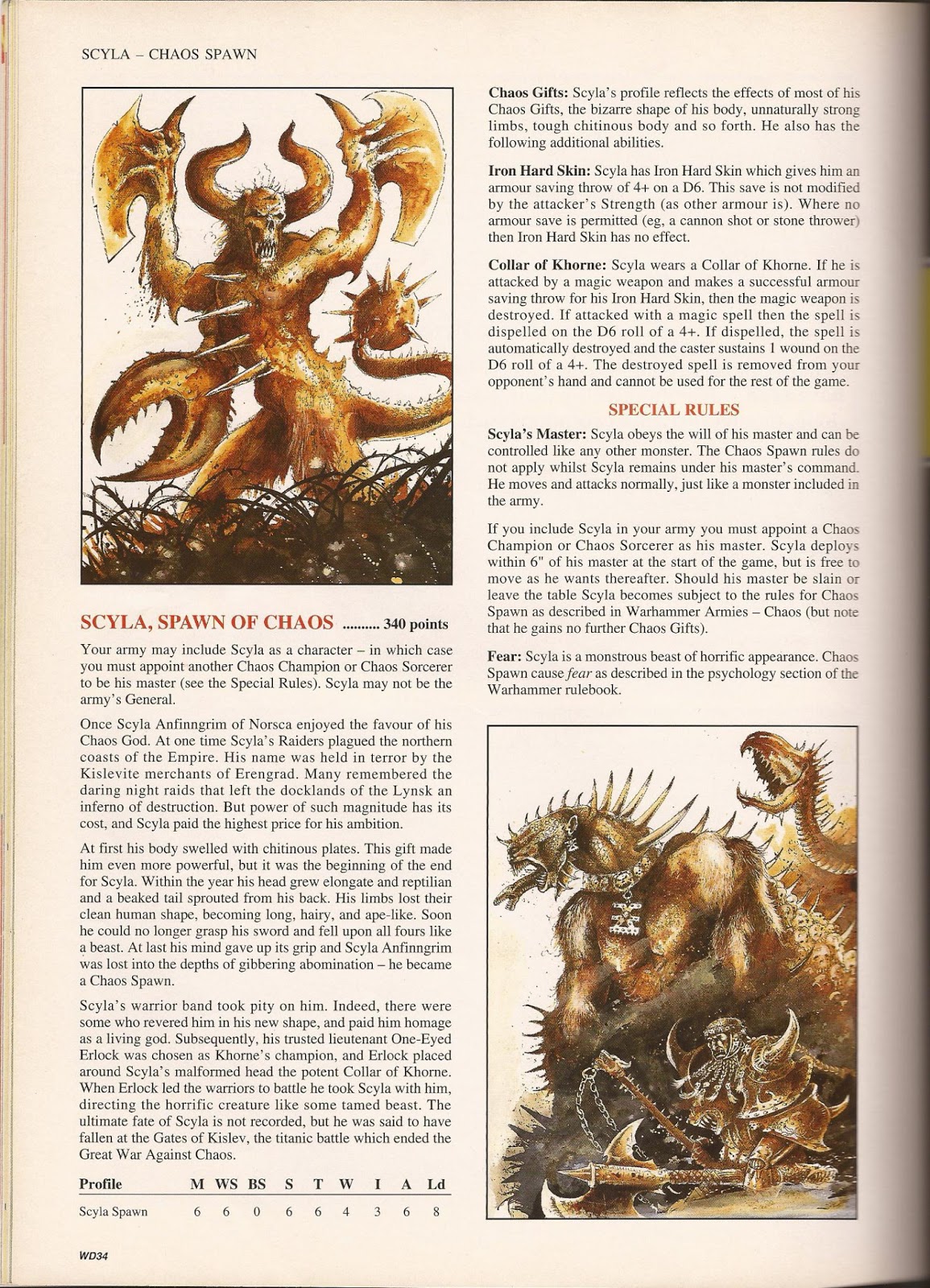
 Sepia toned Spawn

I have written before about how White Dwarf shifted from providing experimental rules and previews to simple re-prints. This is very apparent in 181's Terminator and Sylla articles, lifted directly from the Warhammer 40,000 rules and the Warhammer Armies Chaos book respectively. Unusable without their source rules and valueless with them they have obviously been inserted as cheap promo-material for the new models shown off in big 'Eavy Metal splash pages.

 Advertorial?

While the shift is clearly evident, it was never quite complete, as revealed in the issues two other rules articles. The first is a traditional preview, this time from the forthcoming Codex Imperial Guard which would not be on sale for six months. In Warhammer 40,000 1st edition Imperial Guard troops had been standardised and quite generic sci-fi troops, despite hailing from a multitude of different planets. In second edition GW started pushing a variety of different looking troops from different planets, even if they did fall into the sci-fi trap of making each planet essentially "planet of the one type of weather". So we got Ice Planet, Jungle Planet, Desert Planet etc. This article is a touch more interesting in that it looks at the Atillan Rough Riders, the slightly incongruous Imperial Guard cavalry regiment. The article present a good mix of rules and background material and is clearly usable with the Imperial Guard army list included in the Warhammer 40,000 box set.

The second article is shorter, but arguably more interesting. Over two pages it presents the rules for Imperial Guard chimeras in Epic. On the face of it fairly trivial, but the significance of these rules is that they were never published anywhere else.

Titan Legions, an update but not a new edition of the 6mm game Epic had just been released (for more about this read here). This months cover is taken from the right side of the box art, the left half having been used on White Dwarf 179 two months earlier.

GW put out a number of new models which had not featured in the new game. The problem was that the Epic army supplements, a series of boxes each of which covered two armies, had already been released and, remarkably anyone with any knowledge of modern GW, they were reluctant to release any new editions. Consequently, the rules for these models appeared in White Dwarf. It may have been the intent to update the supplements at a later date, but this never happened and so White Dwarf remains the only source of 2nd edition Epic rules for a surprising collection of models, including the Chimera, the Imperial Thunderbolt fighter and the Nurgle and Slaanesh Daemon engines.

Titan Legions makes its presence felt in another big way this issue, in the form of a huge tactics article about the enormous plastic Imperator Titan included in the boxed set. The article is quite detailed, but it's hard to shake the feeling that it's essentially a promo-piece. The big picture of two Imperators fighting together certainly feels like encouragement to fork out for a second Titan.


A tactics article also provides this issues Blood Bowl coverage, focusing on Undead teams. Third edition Blood Bowl had been released just under a year earlier, but was suffering the fate of many a GW skirmish game. With the supplement and all the models released, there was precious little to write about. Tactics articles were one of the few ways to maintain interest in a game from which GW had already moved on, even if its players hadn't.

This months battle report is something of a departure. Eight players, divided into two teams take part in an epic scale Warhammer battle in which pretty much all the studios Orcs, Goblins and Chaos Dwarfs take on an alliance of the studios Empire army and Mike McVeys Wood Elves. The battle is an unusually loose affair with no real army lists or points values and some quirky rules such as each player having a model representing them and only being allowed to go and have a quiet word with a member of your own team if you models were in base to base contact. All other communication had to be in the form of notes, representing the sorts of messages that generals really could send to one another. The whole affair seems like a lot of fun and has a refreshing emphasis on having a good time without getting overly caught up in rules and game balance.


The huge allied armies offer an insight into the state of studio armies at the time. With most studios miniatures being painted for advertising purposes, the armies are a very mixed bag, with odd unit sizes and an emphasis on characters and unusual units. The haphazard release schedule also leads to some odd elements. For example a small unit of third edition Orc Boarboys sit forlornly in the corner because Games Workshop hadn't bothered to update them. And of course Mike McVey's lushly-painted Wood Elves were entirely third edition models, mixed in with a few Marauder miniatures display pieces. The Wood Elf army book was still a year and a half away. It would be sometime before Games Workshop started to produce studio armies that worked as armies and were painted with a uniform look and feel.


One element that is noticeably absent is any real hobby content. There's no modelling workshops, no conversions on display and no painting articles. 'Eavy Metal has gone from being a show case of well-painted models and tips on how to achieve the same effects, to a display of newly released models, upping the amount of advertorial.

The increased focus on articles that tie-in and, essentially, promote the newest releases makes the issue read more like a promotional tool than a hobby magazine as in the past. Perhaps this is naive and that White Dwarf under GW was never anything more than a promotional tool but it was certainly better hidden two or three years earlier.

Sunday, 3 February 2013

Path to the Realms of Chaos Glory - or changing the rules halfway through

A few days ago I was poking around through my old rule books and came across this:


For anyone who doesn't recognise it, Path to Glory is a small booklet sized supplement, given out free with White Dwarf, providing rules for a skirmish level chaos warband based campaign system. Essentially an update of Realms of Chaos for the then current Warhammer 6th edition Hordes of Chaos army book. Like Realms of Chaos, players start with a basic champion and randomly generate his followers and chaos rewards with more of each being generated over the course of the campaign.

When MLB and I started our Realms of Chaos campaign, I had known that I had a copy tucked away somewhere. But it had much smaller and more limited tables for generating chaos attributes and rewards and its follower tables, brought into line with 6th edition models, had none of the glorious craziness of Warhammer 3rd edition (no halflings, giant snails or zoats in these warbands). So I had dismissed it out of hand and not even bothered to look it up.

It seems that may have been a mistake. While I was right about the limited tables, the supplement has a couple of other useful features. For a start it has a list of simple basic scenarios; the ones in Realms of Chaos are sometimes insanely specific. It also has a rather good victory points table. Realms of Chaos' is not very balanced across the champions of the different gods and hands out points for events that hardly ever occur (such as infecting an enemy with Nurgle's rot) and giving out none for things that actually do happen (like killing enemy followers). Also, while the reward tables are quite limited, they do allow champions profiles to improve. Realms of Chaos is odd in that rewards and attributes only rarely modify a champion's profile and often for the worse leading to the odd anomaly that a champion with a dozen rewards can have a worse profile than most of his follower or, for that matter, a much less experienced champion who happens to have started out as a level 25 hero.


The victory points chart is pretty easy to sneak in, its swapping one chart for another and 3rd and 6th edition Warhammer are similar enough that there isn't anything in the new chart that doesn't make sense in a 3rd edition game. The chaos reward chart with profile upgrades is more complicated, but I am already thinking of ways to make it work. But it has raised some issues for me about modifying written game rules.

I wouldn't have called myself a purist about rules, but when it comes to the point I do feel a bit funny about ignoring, updating or changing the Realms of Chaos rules as written. I think it may have something to do with the age of the game. Playing a RoC campaign has been a goal for a numebr of years and by changing the rules it feels like I'm not quite doing that any more. The victory points table is peripheral enough that it doesn't bother me too much, but changing the chaos reward table feels a bit like stepping over a line.

The other issue is with changing the rules of a campaign half way through. I suppose my issue here is that if you can change the rules at will then you may as well not have them or make them up as you go along. If this were a single game I would play to the end with the rules agreed at the start and make changes during the next game. But when playing a campaign you have a choice to continue with rules you don't like, abandon the campaign and start over with new rules or bite the bullet and make changes that may make things work better but will make the campaign feel inconsistent.

I suspect I will suck it up and make my changes, especially to the victory points, which really do suck in RoC. But it does show the difficulty of rules writing and shows why some player prefer to stick rigidly to the rules as written. The alternative is having to think a bit too hard about what you are doing and why.

Sunday, 20 January 2013

Damned if you do, Damned if you don't

I have stumbled across this rather interesting interview with Rick Priestly on the Realms of Chaos blog. It's short but well worth a read as he is very candid.

It also contains a couple of gems of information I didn't know about. Specifically that Warhammer 4th edition was put together on the cheap. This seemed odd because 4th edition always felt to me to be the point at which Games Workshop shifted from being quite anarchic and random, to much more organised. I have written before about how hard it was for new players to start, something which changed notably during 4th edition.

Thinking about it though, it does make a lot of sense. It was certainly the point at which the number of artists and writers working on Games Workshop products decreased and, if you don't have a pot to piss in, you have to be organised. There isn't the money around to throw at any old project the studio comes up with because you have to get a decent return.

The really interesting comment comes in answer a question about 3rd edition being the least playable version of Warhammer. He equivocates a bit, but generally agrees that it was very sluggish, a comment I can certainly agree with, but it is a throwaway remark that is most interesting to me.

The next edition [4th]was way more energetic and actually got people playing Warhammer again (sales had really slumped prior to that).

The revelation that sales of Warhammer had slumped in 3rd edition certainly fits with my experience. 3rd edition was current when I started playing and the interests of my friends and I was focused firstly on Warhammer 40,000, secondly on Epic and thirdly on some the other games GW produced at the time (such as Space Hulk and Advanced HeroQuest). Warhammer was not on our radar until 4th edition came along and we all started collecting Warhammer armies (I actually had looked at Warhammer prior to this and had the rule books but hadn't persuaded any of my friends to take an interest).

However, I am not sure the reason for Warhammer's poor sales prior to 4th edition had much to do with the rules. My friends and I had never played a game and had no idea how it played. I think the sales slump can be blamed on the absence of new material for the game and the consequent lack of coverage in White Dwarf.

Amazingly it was a good six months or so of reading White Dwarf before I even registered that such a game as Warhammer existed. This may sound odd, but by the time I started reading White Dwarf in 1990, Warhammer and Warhammer Armies had long been released. The only new Warhammer material was from the forthcoming "Realms of Chaos: the Lost and the Damned" book and these articles were titled "Realms of Chaos" so I was assuming that it was a separate game in its own right. The only other Warhammer material were a few 'Eavy metal images, scenery articles, which were effectively generic, and material for other games set in the Warhammer world like Advanced HeroQuest and Warhammer Fantasy Roleplay.

This did change a little over time. White Dwarf started to run a series of spotlight articles on particular players armies, starting, memorably, with Andy Chamber's skaven in White Dwarf 138. It was these articles that sparked my interest in the game. But when 4th edition came along, White Dwarf was saturated with coverage of new models, new rules (mostly army book previews), background (also from army books) and battle reports, then a relatively new idea that really show cased what a Warhammer army could and should look like. All of this did a lot to encourage us to take an interest in the game and build our collections.

For us, and I suspect for many others, what turned our attention to Warhammer wasn't the rules, but an explosion of new models and content.

If my supposition is correct, then it has some intriguing implications. Games Workshop is often castigated for churning out new rules and new editions endlessly in order to cynically encourage sales and "force" players to update the armies in order to keep up with rules changes. In fact Rick Priestly says as much in the interview when he describes the current design studio as "the promotions department of a toy company". But if sales drop when rules and models are not constantly being updated then the question is 'what else are they to do?' To keep up sales you need new material which means, once a game has reached a certain maturity you need endless revisions. Games Workshop are caught between a rock and hard place, castigated for releasing new material, ignored if they don't.

Not that this excuses every bit of bad behaviour from the evil corporate behemoth, but it does make me consider their position in a slightly different, and maybe more sympathetic, light.


Thursday, 10 January 2013

New Years Resolutions

So we've hit January 6th and the Christmas decorations should be down if they were ever up in the first place, the Christmas Radio Times is in the bin, the last of the chocolates used up and things are starting to feel properly like January with all the fog, rain and gloom that that implies. Nice upbeat start to the new year there.

And yet, 2013 feels like a year of possibilities. If 2012 was the year in which the wargaming community collectively went nuts about Kickstarter and Indiegogo, and every company felt it had to crowd source the funding for something, even if it was just their new Kitchen, then 2013 ought to be the year in which a million projects come to fruition.

Of course, to some extent we are already there, Dreadball, Sedition Wars and Zombicide have already made into the shops, but there is still a great deal to come, from Kings of War goodies, to new Bushido models, to Relic Knights, Reaper Bones and a whole bunch of things to which I wasn't paying much attention. So this year should be a fantastic boom time for new miniatures and games.

Either that or it will all be a tremendous flop and we will learn a valuable lesson about not having hope or faith in anything.

Not that the boom is over yet. Rick Priestly and co have just launched the Beyond the Gates of Antares Kickstarter. It's hard to know what to make of this. Other than some nice illustrations, a few bits of background and a list of gaming noteworthies associated with the project we really don't have much to go on. This is apparently the plan however, as the aim is for the players to co-develop the universe and for it to be based around the games we actually play, using the Internet to have players games impact the development of the game Universe in a measurable way.

This is all quite interesting, but I can't help but be a touch sceptical about mixing an online concept with an inherently traditional physical game. Can analogue and digital concepts mesh comfortably? This will be one to watch, though I may still through a few quid at the Kickstarter based on Rick Priestly's name alone.

Turning to myself, if I have an overarching plan for the year, then its to try and be more focused. 2012 was characterised by much activity to only limited effect. I got a lot of models painted, not to mention scenery, acquired a whole new bunch of stuff and yet used very little of it in an actual game. My Inquisitor warbands remain nicely painted (by my standards) in a cabinet, but unused, while the gaming I did do was either with largely unpainted models (Warhammer, Kings of War, Warpath) or with games that don't need painted models at all (Last Night on Earth, Small World, Ticket to Ride).

With that in mind, I have set myself a concrete goal, and only one concrete goal. I will finish painting my Chaos Dwarf army, after leaving it unpainted for nearly twenty years, make some scenery and a new gaming table appropriate for it and actually play a game. I have already made a good start, my Chaos Dwarf warriors and Blunderbusses are done, as is my Iron Daemon and my Bull Centaurs are well underway. Pictures soon, promise.

More important than the goal, however, is my approach to it. This time I will fix on this goal, set no others until its done and not allow myself to be distracted by any other wargaming projects until then. I can play games, even buy new stuff, but no new painting or building until the Chaos Dwarfs are ready.

I really mean it this time, I'm confident I will hold until at least February. And you can hold me to that.

Saturday, 22 December 2012

Dreadball Unboxed

So my copy of Dreadball turned up on Monday. I have to admit I wasn't expecting this. I did get in on the Dreadball Kickstarter, but only at the last minute and missed out on the December release pledges. Consequently, I wasn't expecting it to show up until January, making its arrival something of a pre-Christmas treat.

I don't want to go into the rules right now. For a start, I have only played one demo game. Plus they have already been available in digital form since November and much of the details were all over the Internet before that. Not to mention the designer's copious blog posts going into detail not just about the rules but also almost every design decision that went into creating them. Frankly, I don't feel I have a lot to add to that.

On the other hand, I do have some comments about the actual package.

Previous Mantic board games, Dwarf King's hold and Project Pandora, although decent enough games, were somewhat lacking in quality. Strong box and component art clashed with cheap and rather rough looking cardboard pieces, while the rules manuals were functional rather than striking. This criticism was pretty much accepted by Mantic at their open day back in September and they have taken serious steps to address it here.

Dreadball comes in a large squarish box made from thick card cardboard. Opening it up reveals the rule book, a general leaflet about Dreadball and its forth coming releases and a second leaflet to store your Mantic points, something that has been a long time coming. Mine also came with a rather nice art print of the box cover, though I suspect this won't be a standard feature. The rule book is a similarly high quality product, full colour and perfect bound on glossy paper. It has the look of a book that Mantic could sell separately in a pinch.


Hiding under the rules is the board. Mantic have offered two custom boards, but I stuck with the one in the box and have to say I'm happy. Mantic have maintained the high quality component art of their previous board games, but have mounted it on thick paper wrapped card, for a feel that is far closer to a traditional board game. There is a touch of sagging around the fold in the centre, and the print quality is not as strong as the rule book, but it is still of decent quality.


I speculated a little while back as to whether Dreadball would follow the packaging conventions of a board game or a wargame. I was surprised to find Mantic went with board game. Under the board is a moulded plastic tray with separate spaces for counters and dice, roster sheets and miniatures. I wouldn't have expected this from Games Workshop, so Mantic have done a very nice job here. The cards and roster sheets maintain the high production standards of the box, board and manual.


I think Mantic have been quite canny here. Although to my mind, Dreadball is essentially a wargame, it has been packaged such that it wouldn't look out of place alongside board games. It could sit comfortably in a shop that focuses on board games, or in Smiths or Waterstones, both of which have been expanding their board games selection recently. Dreadball could easily be Mantic's "gateway drug" for new players.


In their own sections of the tray were four bags of models. The largest was the official models included in the base set, in addition to those I also had the Forge Father team, that I had added to my pledge, another bag containing two samples each of Forge Fathers and Veer-myn and  a final bag of MVPs and limited editions. Unfortunately, it was the models that let the package down slightly.

The Human and Marauder Teams included in the box


The models are all resin-plastic (or restic or sprueless plastic or however Mantic is marketing it this week). Generally I have had a pretty good experience with this stuff. It doesn't hold detail quite as well as Games Workshop's Finecast or, for that matter, conventional resin, but it does a good job and has none of the problems of the other materials; no bubbles, air holes or nasty bits of sprue, and little flash or mould lines. It's also a lot more durable. It has shown a marked tendency to warp, but if you put it in some hot water it will soften enough to be bent back in to position.

 MVPs


The problem with the models is that they come in multiple pieces, usually with separate heads often arms and in some cases legs. Unfortunately, the box comes with no instructions on how to assemble them or even explaining that you need super glue and that conventional polystyrene cement won't work. On the plus side the pieces go together well and only minimal clean up was needed.

 Forge Father Team

The rest of the game is packaged like a board game, but having miniatures that need a considerable amount of assembly and prep works against that. It doesn't help that page 7 of the rule book actively encourages you to learn the rules by playing a game and muddling through. This isn't really practical when you have 20+ models to prep and assemble. Without this issue I could see Dreadball being opened Christmas morning and game being played by mid afternoon or at least Boxing day. Perhaps Mantic should have included some counters to represent the players so at least you could get in a game straight away.

It's a shame, because the models look very nice and I certainly have plenty of them, but, unfortunately, they work against the style of the rest of the package. So, high quality components, well packaged, addressing many of the faults with previous Mantic releases, but, sadly, not quite perfect.

Monday, 3 December 2012

The Battle of Wurtbad

The market town of Wurtbad in the Northern Empire was to receive a rude awakening when the warning bells tolled. Grown fat from the town's annual beer festival, it was all too tempting a prospect for the hastily assembled alliance of Chaos Worshippers now approaching the town.

Magraf Adolphus Von Rachoff had been dreading this. Ever since the river Wurt had burst its banks leading to flooding and the collapse of part of the town wall, Wurtbad had been all too vulnerable. Unfortunately, the town Burgers, always with an eye on short term profit, had refused the funds to make necessary repairs. They would live to regret it when their coffers were carried off by beastmen, assuming they lived of course.

There was no time for recriminations, Adolphus had to focus on the town's defence. He rallied the town guard under Captain Borgen and set about equipping a hastily arranged militia with what weapons could be found, mostly pikes and crossbows but a handful of serviceable arquebus were included. The towns ageing cannon was pressed into service and a group of Bergjaeger woodsmen offered their services and their archery skills. Most fortunately of all, the Wizard Johannes Breckner, in town for the festival, mounted his horse and agreed to offer what magic he could.

With the defenders prepared, Adolphus deployed a number to defend the town, but kept the bulk of his forces on a hill just outside the town borders in the hope of distracting the chaos worshippers attention from the town itself.

We decided that I would nominally be in command of the Fetid Alliance, while MLB would command the Defenders of Wurtbad. I say nominally because the intent was not play a strictly competitive game. For a start, I would be in command of MLBs warband. But also, we wanted to play an interesting game that would develop the narrative of our ongoing campaign. Who won or lost was secondary.

We decided that in addition to the standard victory points table, if Chaos won the champions would take 10 victory points each. This is standard for a winning side in most of the scenarios outlined in Realms of Chaos: the Lost and the Damned.

Deployment - click on any picture for a better view

The cacophonous sound of a beastmen horn signalled the Chaos advance. The warbands advanced on the left flank accompanied by the diseased flagellants and there foul altar. On the Chaos right flank, Balios the Corpulent lead his Zombies towards the hill occupied by the Magraf.

At a signal from Adolphus, the Empire missile troops opened fire. Flaggelents and Zombies fell, but the warbands were unharmed and the advanced continued largely unimpeded.

Missile attacks from the arquebus and crossbows did almost no damage. Some Zombies fell to cannon fire, but not enough to have any serious effect.

As Rolf Hurtziger's warband approached the town, the brave men of the town militia, lead by Captain Borgen advanced to meet them, halberds at the ready. Sensing blood, the Chaos worshippers quickened their pace before launching into an ill organised charge.

Rolf's warband advances on the Hellblitzen while Owesteen's warband turns their attention to the Bergjaeger

As the battle lines met, Rolf declared a challenge, accepted willingly by Captain Borgen. The two champions were evenly matched, axe and sword clashed. There was a break in the fighting and then both men collapsed.

Enraged at the loss of their leader, Rolf's followers attacked with renewed and maniacal vigour. The militia were forced back, gave ground and then turned and fled back to the town with the vile Chaos worshippers in hot pursuit.


Captain Borgen and Rolf Hurtziger were both level 5 heroes with almost identical profiles. Rolf's mark of Nurgle gave him +1 toughness, but there was nothing else in it. With nearly identical profiles, they struck simultaneously and both went down. On the other hand, humans with halberds clearly weren't a match for a Dragon Ogre, beastmen and Orcs with spears. The halberdiers failed their break test, but in 3rd edition that didn't mean instant death, just running away with the warband following and hacking at them further. The pursuit would keep the warband occupied for most of the game.

In the centre, the warband of the Dark Elf Owesteen clashed with the Bergjaeger . Owesteen had expected easy prey, but the woodsmen put up a stern resistance.

But it was on the right flank that the battle was to be decided. Balios Plague Zombies charged uphill to meet the Magraf's pikemen. Despite the hideous appearance of their opponents, the pikemen held out. Balios and the Magraf clashed, ineffectually at first, but then the Magraf slipped past the foul Champion's defences and delivered a killing blow with the sacred Warhammer. Balios fell and his remaining Zombies driven into the ground and crushed. The triumphant defenders reformed and turned to face the rest of the Chaos raiders, only to see Rolf's warband advancing into the town.

 An uphill struggle for Balios and the Zombies

Both the Magraf and Balios were level 15 heroes and about as evenly matched as Rolf and Captain Borgen. One round of combat saw both champions completely miss each other. The second round wasn't much better, but luckily for the Magraf he managed to get in two hits and made excellent use of the hammers might strike (1 strength 10 hit per game) and enchanted strike (2 wounds) to bring Balios down.

It was at this point, with both armies right flank collapsing, it became clear that we were not going to get a clear cut outcome to the game. Neither one of us was particularly keen to see our carefully nurtured warbands have to battle to the death and with the speed at which 3rd edition combat is resolved we could have been there all day in any case.

We decided that if at least half the chaos units made into the town before the end of the game, they would be able to make off with enough plunder to claim a draw and get five victory points per champion. This felt like the most narratively satisfying outcome. Quite apart from anything else, a good part of the fun of Realms of Chaos comes  from rolling on the chaos reward table and you can't do that without a few victory points.

The lesson we took from all this was to always make sure that you iron out your victory conditions properly before you start playing the game and remember to consider the possibility of a draw.

With Magraf Adolphus and his pikemen and crossbows bearing down on him, Owesteen, having lost the rest of his warband, finally managed to finish off the scouts and turned to face the rapidly advancing pikemen. Reasoning that it was better to charge and take the initiative, that be skewered by crossbow bolts and blown to pieces by cannon fire, charged the Magraf.

Back in the centre, the diseased flagellants had finally crossed the river and engaged the aqruebus. Enhanced by the power of the Chaos altar, the deranged fanatics were more than a match for the men of Wurtbad, but, although forced to give ground, the defenders stubbornly refused to flee.

 Owesteen battles the Magraf while the Diseased Flagellants finish of the Hakbutschutzen

Despite a valiant struggle, Owesteen the Dark Elf fell to the Margraf's hammer. But by now, Rolf's warband and the diseased Flagellants had made their way into Wurtbad.

With two units having made it into the town, this was the point at which we stopped the game and declared it a draw. Both champions were able to claim five victory points, but with both having been "killed" during the fighting they didn't get any extra points for having survived the battle. Fortunately, for Owesteen the five victory points were just enough, with the points accumulated from a previous battle, to tip him over the edge and give him a roll on the Chaos Reward table. This turned out to be the chaos attribute feathers. Rolf, however, didn't earn enough for another roll. Luckily for both warbands, they no-one suffered any permanent injuries.

Overall it had been an interesting game. Using the warbands as complete units had been more straight forward than expected and the rules scaled comfortably well to 1000 points. Having said that, the combats dragged out for turns and Missile fire was also almost entirely ineffective. I suspect playing at the 'official' standard 3000 points would have taken ages.

That said, as the warbands grow it would be worth bringing them back together for another large scale battle, possibly bringing in an allied warband worshipping another God.

Although some of the followers of Chaos had made it into the town, they were quickly driven out by the Magraf's troops. The town had been saved, but, secretly, the Magraf hoped the town burgers had been scared enough not to neglect its defences in future.

Sunday, 25 November 2012

Miniature Games vs Board Games

So what is the difference between a board game and a table top wargame? Apart from the obvious that is. Actually, that bears some examination, because there are some games that have boards that feel very much like tabletop mini games. Bloodbowl and Dreadball are obvious examples, then there's Space Hulk, Warhammer Quest, Mantic's Dwarf King's hold and Project Pandora and of course Dust Tactics. Does Dreadfleet's battle mat count as a board? And Anima Tactics, intended as a TMG its appendix includes rules for using a board, so is it a board game when you use the board and a TMG at other times?

Going the other way, I have always thought of as medieval-themed tile game Carcassone a board game, but do its brightly coloured tiles qualify as a board?

I have to say at this point I don't spend a large a lot of time pondering this issue. I'm not one of those pedantic types who defines myself as a wargamer or a boardgamer and insists that never the twain shall meet. The question only interests me because it says something about the way we use language and the way we think about games.

With that in mind, I have got what I think is a slightly better definition. To my mind a board game is an essentially self-contained product in a way that a wargame is not. Obviously this requires a little more explanation as there is no shortage of expansions for board games. Frankly, the back catalogue of some board game expansions is enough to keep some companies afloat by themselves cough#Munchkin#cough.

What I mean, is that the intent of a board game is that a single person can buy a copy, and the optional expansions if they so choose, and have a self-contained product that can be played with a group. There is no intent for each player to bring their own copy. In contrast, in a TMG each player is expected to collect their own army/warband/gang/crew/team of models. Of course some players like to collect multiple armies so that players with no army of their own can still join in, but the clear intent is that each player brings their own models.

The funny thing about this definition is that Blood Bowl and Dreadball would be considered TMGs while Space Hulk, Dwarf King's Hold and Dreadfleet would be board games.

I have been reasonably happy with my home made definition for a while now, but this past weekend something happened that gave me a different perspective.

Last Saturday was Warfare Reading, Reading's premiere, and indeed only, Wargames event. Unusually for me my target wasn't new miniatures, but board games, specifically the Zombie apocalypse themed Last Night on Earth and Zombicide. Both games involve the killing of Zombies, but approach this theme quite differently. Last night on Earth is strongly atmospheric and tactical, while Zombicide focuses on straightforward cartoony action.

Most boardgames, particularly the more expensive ones, are packaged so that the game components can be easily be stored in the box. Usually this is some kind of plastic tray molded to hold the cards and counters specific to the game. Small World from Days of Wonder has one of the most elaborate. In addition to the specially molded tray, it also includes a separate removable tray specifically for the large collection of counters the game requires.


Not all games go quite this far, the aforementioned Carcasonne simply has a cardboard insert. Nevertheless, there is sense that the game and the box are part of a single self contained product.


Last night on Earth follows this pattern exactly.


When you open up Zombicide you get something quite different.


The two large boxes contain the plastic trays of miniatures.


There is a seperate plastic holder for the cards, dice and experience markers, but the cards bulge over the top. This is fine when they are still sealed in plastic, but they start to spread out when put in loosely.


The miniatures and board sections fit quite snuggly, but there is also a single sheet of card counters which sits on top. Unfortunately, once the counters are punched out there is nowhere for them to go.

As I rummaged around for a plastic sandwich bag to store the counters I remembered that I had had to do the same thing with my copies of Blood Bowl, Space Hulk and Warhammer Quest. Although Games Workshop have produced a number of games that are arguably board games they have never followed the board game convention of including a means of storing the components. Mantic have followed the same pattern with Dwarf King's Hold and Project Pandora. When companies focused on TMG games produce board games they tend to treat the boxes the same way as boxes of miniatures, as a mechanism of transporting the miniatures without them falling all over the floor.

This leads me to wonder if Zombicide was produced with more of a TMG sensibility than a board game sensibility. It also leads me to wonder how Dreadball will be packaged when it is ready.

But what is really strange about all this is that, until now, packaging never entered my head when considering the definition of a game and yet I come away from this feeling as though Last Night on Earth is a board game and Zombicide is a table top miniature game.