When getting used to a new set of rules, the first few games tend to be a pretty uneven affair, characterised by a lot of flicking back and forth through rulebooks and checking stats. I'll admit that these early games are not always a lot of fun to play; I'm far too busy trying to keep track of the rules to think about tactics and victory or defeat all to often depends on whether you got the rules right.
It's for this reason I find myself gravitating back to Warhammer so often. It's not that I think it's the best set of rules, it isn't, but for most of the 1990s it was, for me, literally the only game in town. I have played it so much over the years that the fundamentals are second nature and when new editions come along, I just have to be on the look out for the changes.
This is why I think Mantic have been very smart with Warpath and Kings of War. Here we have two examples of a set of rules that are designed to be easy to learn and play at the exclusion of all else. This can lead to some odd quirks. Nevertheless, I am more willing to play these two than a number of games I have previously played more, simply because I know I am not going to have to look very much up and I can concentrate on the business of actually playing.
The trend in Fantasy and Sci-Fi gaming in recent years has been towards smaller scale skirmish games. This has the advantage that I can build a usable force more quickly and cheaply, even when individual models cost more than Games Workshop (at least until the advent of Finecast). If you I need five to ten models a side, you're much less likely to baulk at paying £10 a model. And you can focus more time and effort painting individual models and still get them painted more quickly. I have a larger proportion of my Anima Tactics models painted than I ever have with Games Workshop.
The drawback is it does tend to split my collection across lots of different games. Money and time I would have spent building up one army, ends up diffused across multiple gangs, crews or factions. And this means more rules to learn. Unsurprisingly, I find myself gravitating towards the systems where the rules are easiest to learn.
I have all but abandoned Malifaux, largely because it combines an unusual random mechanism, based around playing cards, with a large number of special rules for most models and a complicated abbreviation system for keeping track of them. Then there's Bushido, a game I like and really want to play more, but which, unfortunately, has one mechanism for activation (two short or one long action per turn), one for special abilities (points that are accumulated turn by turn, but which can be stored across multiple turns) and another for combat (a pool of combat dice that have to be divided between attack and defence and which can be sacrificed to produce additional effects).
One of the things I have always liked about Anima Tactics is that it has very few mechanisms to control things. Activation is based on action points that are renewed at the start of the turn, special abilities are mostly special actions that work in the same way and most effects are resolved by rolling a d10 adding a stat and modifiers and comparing it to a target number or the opposing players roll. Dreadball, and soon Deadzone, use a similar mechanism of rolling multiple dice, trying to equal or exceed a target number and counting the number of successful rolls. Even the badly presented Infinity rules, have the advantage of a single dice mechanism which covers most situations.
I wonder how often 'ease of learning' is factored into rules design? I know Jake Thornton has said he favours rules that are quick to learn but with plenty of tactical depth. But with some designers it feels like depth is being confused with complexity. I also wonder if my experience with Warhammer tells us anything. When your playing the same game day after day it becomes second nature and it's all to easy to forget how baffling it can appear to outsiders.
Showing posts with label Dreadball. Show all posts
Showing posts with label Dreadball. Show all posts
Tuesday, 18 June 2013

Saturday, 22 December 2012
Dreadball Unboxed
So my copy of Dreadball turned up on Monday. I have to admit I wasn't expecting this. I did get in on the Dreadball Kickstarter, but only at the last minute and missed out on the December release pledges. Consequently, I wasn't expecting it to show up until January, making its arrival something of a pre-Christmas treat.
I don't want to go into the rules right now. For a start, I have only played one demo game. Plus they have already been available in digital form since November and much of the details were all over the Internet before that. Not to mention the designer's copious blog posts going into detail not just about the rules but also almost every design decision that went into creating them. Frankly, I don't feel I have a lot to add to that.
On the other hand, I do have some comments about the actual package.
Previous Mantic board games, Dwarf King's hold and Project Pandora, although decent enough games, were somewhat lacking in quality. Strong box and component art clashed with cheap and rather rough looking cardboard pieces, while the rules manuals were functional rather than striking. This criticism was pretty much accepted by Mantic at their open day back in September and they have taken serious steps to address it here.
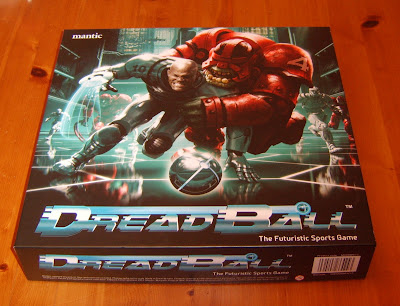
Dreadball comes in a large squarish box made from thick card cardboard. Opening it up reveals the rule book, a general leaflet about Dreadball and its forth coming releases and a second leaflet to store your Mantic points, something that has been a long time coming. Mine also came with a rather nice art print of the box cover, though I suspect this won't be a standard feature. The rule book is a similarly high quality product, full colour and perfect bound on glossy paper. It has the look of a book that Mantic could sell separately in a pinch.
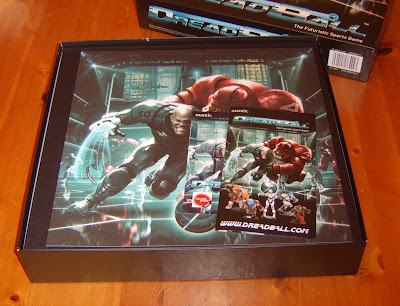
Hiding under the rules is the board. Mantic have offered two custom boards, but I stuck with the one in the box and have to say I'm happy. Mantic have maintained the high quality component art of their previous board games, but have mounted it on thick paper wrapped card, for a feel that is far closer to a traditional board game. There is a touch of sagging around the fold in the centre, and the print quality is not as strong as the rule book, but it is still of decent quality.
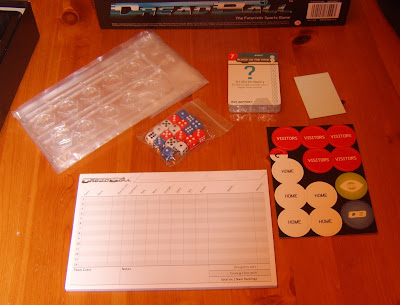
I speculated a little while back as to whether Dreadball would follow the packaging conventions of a board game or a wargame. I was surprised to find Mantic went with board game. Under the board is a moulded plastic tray with separate spaces for counters and dice, roster sheets and miniatures. I wouldn't have expected this from Games Workshop, so Mantic have done a very nice job here. The cards and roster sheets maintain the high production standards of the box, board and manual.
I think Mantic have been quite canny here. Although to my mind, Dreadball is essentially a wargame, it has been packaged such that it wouldn't look out of place alongside board games. It could sit comfortably in a shop that focuses on board games, or in Smiths or Waterstones, both of which have been expanding their board games selection recently. Dreadball could easily be Mantic's "gateway drug" for new players.
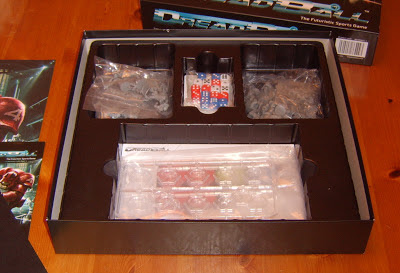
In their own sections of the tray were four bags of models. The largest was the official models included in the base set, in addition to those I also had the Forge Father team, that I had added to my pledge, another bag containing two samples each of Forge Fathers and Veer-myn and a final bag of MVPs and limited editions. Unfortunately, it was the models that let the package down slightly.

The models are all resin-plastic (or restic or sprueless plastic or however Mantic is marketing it this week). Generally I have had a pretty good experience with this stuff. It doesn't hold detail quite as well as Games Workshop's Finecast or, for that matter, conventional resin, but it does a good job and has none of the problems of the other materials; no bubbles, air holes or nasty bits of sprue, and little flash or mould lines. It's also a lot more durable. It has shown a marked tendency to warp, but if you put it in some hot water it will soften enough to be bent back in to position.
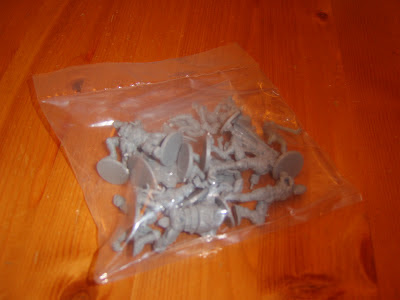
The problem with the models is that they come in multiple pieces, usually with separate heads often arms and in some cases legs. Unfortunately, the box comes with no instructions on how to assemble them or even explaining that you need super glue and that conventional polystyrene cement won't work. On the plus side the pieces go together well and only minimal clean up was needed.
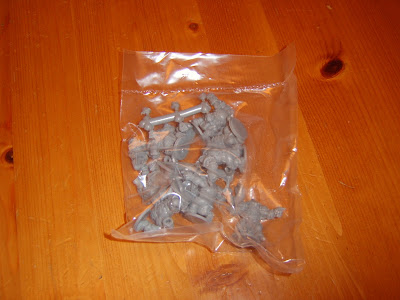
The rest of the game is packaged like a board game, but having miniatures that need a considerable amount of assembly and prep works against that. It doesn't help that page 7 of the rule book actively encourages you to learn the rules by playing a game and muddling through. This isn't really practical when you have 20+ models to prep and assemble. Without this issue I could see Dreadball being opened Christmas morning and game being played by mid afternoon or at least Boxing day. Perhaps Mantic should have included some counters to represent the players so at least you could get in a game straight away.
It's a shame, because the models look very nice and I certainly have plenty of them, but, unfortunately, they work against the style of the rest of the package. So, high quality components, well packaged, addressing many of the faults with previous Mantic releases, but, sadly, not quite perfect.
I don't want to go into the rules right now. For a start, I have only played one demo game. Plus they have already been available in digital form since November and much of the details were all over the Internet before that. Not to mention the designer's copious blog posts going into detail not just about the rules but also almost every design decision that went into creating them. Frankly, I don't feel I have a lot to add to that.
On the other hand, I do have some comments about the actual package.
Previous Mantic board games, Dwarf King's hold and Project Pandora, although decent enough games, were somewhat lacking in quality. Strong box and component art clashed with cheap and rather rough looking cardboard pieces, while the rules manuals were functional rather than striking. This criticism was pretty much accepted by Mantic at their open day back in September and they have taken serious steps to address it here.
Dreadball comes in a large squarish box made from thick card cardboard. Opening it up reveals the rule book, a general leaflet about Dreadball and its forth coming releases and a second leaflet to store your Mantic points, something that has been a long time coming. Mine also came with a rather nice art print of the box cover, though I suspect this won't be a standard feature. The rule book is a similarly high quality product, full colour and perfect bound on glossy paper. It has the look of a book that Mantic could sell separately in a pinch.

Hiding under the rules is the board. Mantic have offered two custom boards, but I stuck with the one in the box and have to say I'm happy. Mantic have maintained the high quality component art of their previous board games, but have mounted it on thick paper wrapped card, for a feel that is far closer to a traditional board game. There is a touch of sagging around the fold in the centre, and the print quality is not as strong as the rule book, but it is still of decent quality.

I speculated a little while back as to whether Dreadball would follow the packaging conventions of a board game or a wargame. I was surprised to find Mantic went with board game. Under the board is a moulded plastic tray with separate spaces for counters and dice, roster sheets and miniatures. I wouldn't have expected this from Games Workshop, so Mantic have done a very nice job here. The cards and roster sheets maintain the high production standards of the box, board and manual.

I think Mantic have been quite canny here. Although to my mind, Dreadball is essentially a wargame, it has been packaged such that it wouldn't look out of place alongside board games. It could sit comfortably in a shop that focuses on board games, or in Smiths or Waterstones, both of which have been expanding their board games selection recently. Dreadball could easily be Mantic's "gateway drug" for new players.

In their own sections of the tray were four bags of models. The largest was the official models included in the base set, in addition to those I also had the Forge Father team, that I had added to my pledge, another bag containing two samples each of Forge Fathers and Veer-myn and a final bag of MVPs and limited editions. Unfortunately, it was the models that let the package down slightly.

The Human and Marauder Teams included in the box
The models are all resin-plastic (or restic or sprueless plastic or however Mantic is marketing it this week). Generally I have had a pretty good experience with this stuff. It doesn't hold detail quite as well as Games Workshop's Finecast or, for that matter, conventional resin, but it does a good job and has none of the problems of the other materials; no bubbles, air holes or nasty bits of sprue, and little flash or mould lines. It's also a lot more durable. It has shown a marked tendency to warp, but if you put it in some hot water it will soften enough to be bent back in to position.

MVPs
The problem with the models is that they come in multiple pieces, usually with separate heads often arms and in some cases legs. Unfortunately, the box comes with no instructions on how to assemble them or even explaining that you need super glue and that conventional polystyrene cement won't work. On the plus side the pieces go together well and only minimal clean up was needed.

Forge Father Team
It's a shame, because the models look very nice and I certainly have plenty of them, but, unfortunately, they work against the style of the rest of the package. So, high quality components, well packaged, addressing many of the faults with previous Mantic releases, but, sadly, not quite perfect.
Monday, 5 November 2012
A true original?
Poor old Jake Thornton, no sooner does he announce plans to self-publish a new skirmish game then the first comment, the very first comment, assumes he will be ripping off Games Workshop. I can't say I blame him for writing a blog post on the subject. Since Dreadball a vocal part of the wargaming community seem to have decided that he is simply copies existing games.
That said, me writing a whole blog post on the subject probably doesn't help. So, before I go any further, I should say that I think his skirmish game Eternal Battles sounds very interesting. The plan is for a modular structure with the basic rules covered in one volume and multiple add on modules to cover different periods. I will be watching with interest.
I still want to talk about the "rip off" accusation though because it illustrates something quite interesting about the attitude of some gamers.
It's odd that Dreadball attracted such criticism, actually. There have been dozens of mass battle, dungeon crawl, space ship exploration and skirmish games released without anyone batting an eyelid. Maybe it's because Blood Bowl feels like one of Games Workshop's few truly original ideas. I say truly original, but even then it's a splice of two existing concepts, Warhammer Fantasy and American Football. Nevertheless, it does seem to be associated with Games Workshop more firmly than any other game concept ad has a lot of loyal fans.
Still, the attitude to Dreadball suggests that its critics believe there is only one legitimate route to design a game. That is to start with a totally original concept and then right rules to simulate it. That is certainly the route taken by some games; Malifaux and War Machine spring to mind. But this isn't the only route.
Take a look at historical gaming. There are games for all different periods and conflicts and the most popular periods are supported by multiple rules sets. Fields of Glory, Hail Caesar, Clash of Empires, War and Conquest, as well as others, all cover the ancient to medieval period, but all do so in a different way. Some rules focus in on a very particular period, such as Beneath the Lilly Banner, Killer Katanas or Saga, while others cover a much broader period, such as Pike and Shotte. When Warlord released Bolt Action recently Alessio Cavatore and Rick Priestly didn't receive any criticism for writing rules based on a period that has already been covered by other games. Not to say there wasn't any criticism, but not for that. Possibly this is because in historical gaming everything is based on actual history so no-one can be accused of ripping anyone else off based on this.
But historical gaming also illustrates a different approach to designing a game, namely looking at an existing period or concept and trying to simulate it with a different set of rules. As far as I can see, with Bolt Action the designers had a unique selling point based on the rules, the order dice, and built the game from there.
Why is this not an appropriate approach to take to Fantasy and Sci-Fi gaming. If a designer has a new way of simulating fantasy skirmish or mass battle or even sport why not build a game around it? Surely not every game has to be completely unique?
Now lets take a look at the current state of Blood Bowl. It is still formally available, but has been tucked away in the Specialist games area of the Games Workshop website, with no formal support and no new models for years. Many of the existing models haven't been updated since the mid 1990s. The game is effectively retired. So what is a designer with a good idea for a sports-based game supposed to do? Forget about it because Games Workshop have a game vaguely similar they hardly support? Whatever else you might say about Mantic they certainly have big plans for Dreadball with three supplements and twelve teams planned and no shortage of additional material.
So from the perspective of gamers Dreadball looks like good news. It's an interesting rules set and the game looks well supported. Should the whole concept have been dropped simply because it is vaguely similar to a game Games Workshop have all but abandoned? I think not.
I'm already signed up to Dreadball, I put money into the Kickstarter and will be keeping an eye on Eternal Battle and I hope that no good games are strangled at birth because tehy are judged insufficiently original.
Subscribe to:
Posts (Atom)