Recently, I've been doing my best to cut back on the amount of miniatures I've been buying. For the first time in about five years I skipped the "Call to Arms" show in Theale, on the grounds that I would just bring back more stuff that I didn't have time to assemble or paint. Of course, I blew it slightly by taking a trip into London and buying two more models for Bushido instead.
Bushido has acted as something of an exception to my "no new models" rule, largely because I want to keep up to date with the Temple of Ro-kan faction. But the fact that I have allowed this exception, says something about the effectiveness of GCT's marketing.
Games Workshop games are all but armies for me. I pick an army and buy models until it feels big enough. And then GW try to encourage me to start a new army. I don't expect to collect every model or unit available for the army and I may even restrict my choices to make it more thematic. While I wouldn't describe any of my armies as "finished" exactly, they are all of a size were I don't feel any great pressure to add any more models to any of them.
Oddly, Games Workshop's release pattern helps reinforces this behaviour. Every five years or so they release a new army book, I buy it and maybe one or two units or characters and that's it. My army is up to date. I don't feel the need to replace my existing models. Take the new dwarf book, I will probably grab it, King Duregar and a Gyrobomber and leave it at that. I won't replace my carefully painted metal hammerers with the new plastics any more than I replace my beloved metal miners when the plastic miners came along.
Bushido is different. For some reason, Bushido doesn't feel bounded in the same way as my Warhammer armies, so every time a new release comes along for the Temple of Ro-Kan, I buy it. Due to a combination of the small number of models required to play the game and the relatively low cost of each, I have started thinking of my Bushido models as a "collection" and not an army. Which means I need to buy the lot. Because new models are released every two months or so, there is never a natural pause and so I keep buying.
Bushido isn't the only game to do this. Warmachine/Hordes, Infinity, Malifaux, Helldorado, even Anima Tactics if it was more organised, all depend on a model of steady and constant releases, which keeps you army/gang/warband/crew in a permanently incomplete state.
It reminds me of when I was seriously into Magic the Gathering. Every time a new expansion appeared I had to buy a few boosters or feel like the game was leaving me behind. Consequently, the collection was never complete only constantly expanding. This is great for the company, as they get a steady income. The drawback is that players have to be pretty devoted to the game to keep up. Part of the reason I never really got into Warmachine was because I couldn't get the old models assembled painted and on the table before the next expansion came out, not when there was so many other games out there. As a marketing strategy, it encourages the fanatic at the expense of the casual gamer.
Of course much of the pressure is self-imposed. I have more than enough Bushido models to game with and I really don't need any more. And yet the pull is still there and, for the moment at least, I can keep up with the new releases without it totally monopolising my time.
In the last few months I have found myself drawn back to games that have effectively "died." Games Workshop's Epic and Mordheim and Confrontation. It's the lack of new releases that is the draw in these cases. With no more support coming, the games are "finite" and I can concentrate on painting and gaming with the models I have without feeling a compulsion to buy any more. Except, of course, for those last one or two Mordheim models I might get from Ebay...
Showing posts with label Hordes. Show all posts
Showing posts with label Hordes. Show all posts
Friday, 28 February 2014

Monday, 9 July 2012
The Role of Narrative
In my last post I wrote about how Inquisitor is an odd miss-match between a range of models based on specific characters and a game system that emphasised creating characters of your own. It seems odd that this miss-match would have come about when the concept for the model range came first and Inquisitor was one of many game ideas on the table. In fact, that a game of this type was ultimately produced says something about Games Workshop and its history.
The history of Games Workshop games does not begin with Warhammer, but to a large extent, the company that it is now began with Warhammer. Prior to the release of Warhammer 1st edition, most fantasy miniatures were used as props for Roleplaying games (which themselves evolved from Wargaming, but that's another story). Warhammer was essentially a slightly different thing to do with your fantasy miniatures. I put "slightly" because 1st edition Warhammer was still substantially a Roleplaying game. It was supposed to use a Games Master, have player created characters and "adventures" rather than scenarios. The concept of competing players each with their own armies, really developed from 2nd edition onwards.

However, the roleplaying concepts were not forgotten. 3rd edition Warhammer is particularly interesting. The 3rd edition rulebook was written as if it were a stand-alone system, the dedicated army list book Warhammer Armies, came later and appears to have been written to support tournament play. The basic rule book has no army lists, but it does have an extensive bestiary of fantasy creatures with points values for all of them. In addition, it includes rules and points values for a number of specialist troop types. These included Shock and Missile elites who were simply better at fighting or shooting, but also included more unusual troops like scouts, skirmishers, assassins, flagellants and berserkers. The interesting thing is that these specialist types were included as upgrades to existing troops. So if you wanted to create a goblin assassin or an elf berserker you could, and adjust the points values accordingly.
Characters were also presented as upgrades. They were given levels from 5 to 25 and these represented the number of bonuses applied to troops' profiles. The interesting thing was that these bonuses were variable, with six different options presented allowing more combat orientated or leadership orientated characters (though one was presented as the standard version to use in tournaments).

When Warhammer 40,000 was released a similar system was presented, with tables for randomly generating troops and characters and with an emphasis on scenario-based game play.
In subsequent editions, these ideas have been diluted, but elements remain. Standard Games Workshop characters are still generic types upgraded by players with equipment and/or magic items. Units vary in numbers and can frequently be upgraded with different weapon options as well as extra elements like standard bearers, musicians and champions.
This sort of approach is common for games produced independent of a range of models, such as Hordes of the Things, Armies or Arcana, Song of Blades and Heroes or Warrior Heroes: Armies and Adventurers. This is understandable as the game needs to be adaptable to players miniatures. It is more unusual for games and miniature ranges produced together.
For example in War Machine and Hordes, the number of models in a unit can vary, but not their equipment. Some can be upgraded with additional specialist models, but not all. Warjacks and Warbeasts are defined types with standard equipment. And all characters are named individuals with a defined range of abilities and equipment. The same is true of Malifaux, Helldorado, Bushido and Anima Tactics. All of them emphasise named characters with only limited, if any, upgrade options for individual troops.
Warhammer's origins as a hybrid roleplaying game has bled across into other Games Workshop games. Inquisitor, with its player-created warbands of characters has already been mentioned, but it also present in Mordheim, Necromunda and Blood Bowl. All of which feature a campaign system that emphasises gangs/warbands/teams developing over time as games are played. This system was transferred to the Warhammer Historicals Legends of the Old West and Legends of the High Seas, though the first time something like this was attempted was in Realms of Chaos.
Interestingly, it is not an approach adopted by most other Fantasy and Sci-Fi skirmish games. Bushido, Infinity, Anima Tactics, Malifaux, all of these games are of a scale similar to the Games Workshop games, but none of them have taken this route, instead opting to focus on characters created by the games designers, rather than the players.
Most of these games focus on a strongly defined game world, many with an evolving narrative. This is particularly true of Malifaux, whose narrative has developed with each rule book to the point where it seems that the writers aren't entirely sure if they're writing a rulebook or a novel. It is also true of War Machine and Hordes. In contrast, the narrative of the Warhammer world has hardly moved on in twenty five years. The game world has changed, but this has mostly consisted of retconning the existing background to fit the development of new armies. There is not a defined ongoing story.
And yet this actually fits better with the narrative approach that Games Workshop takes with its games. They present a well defined, but essentially static game world and invite players to create their own characters and develop their own narratives. The campaigns that have been built up around the Games Workshop skirmish games develop a life and a story of their own, rather than following a story defined by the game writers.
In contrast, most of the other games listed above present a strong, developing narrative and use it as a back drop. Players have essentially three choices. The first is to ignore the background and focus on the game. The narrative provides a theme to build a game and miniatures, but little more than that. This is essentially the way that card games, such as Magic the Gathering or board games work. Nobody thinks that Settlers of Catan accurately reflects the settlement of an island or Monopoly running a property empire, but it doesn't matter. The second option is to try and play within the limits of the background, much as some historical gamers prefer only to play games based around known historical events and campaigns. The third option is to develop your own background or play "what if" games that develop the official narrative in a direction of the players choosing.
What these games pointedly do not do, which most Games Workshop games do, is provide a narrative with sufficient space for players to develop their own characters and stories that still fit into the overarching story of the game world.
For some players this does not matter. Many players view wargaming as imply gaming and the narrative is of minor or no importance. But for others, developing a narrative around your characters and armies is part of the enjoyment of wargaming. And, for all the legitimate criticism aimed at it, this is one thing that Games Workshop has done well in the past and that other Sci-Fi and Fantasy games, for all their positive qualities, often neglect.
The history of Games Workshop games does not begin with Warhammer, but to a large extent, the company that it is now began with Warhammer. Prior to the release of Warhammer 1st edition, most fantasy miniatures were used as props for Roleplaying games (which themselves evolved from Wargaming, but that's another story). Warhammer was essentially a slightly different thing to do with your fantasy miniatures. I put "slightly" because 1st edition Warhammer was still substantially a Roleplaying game. It was supposed to use a Games Master, have player created characters and "adventures" rather than scenarios. The concept of competing players each with their own armies, really developed from 2nd edition onwards.
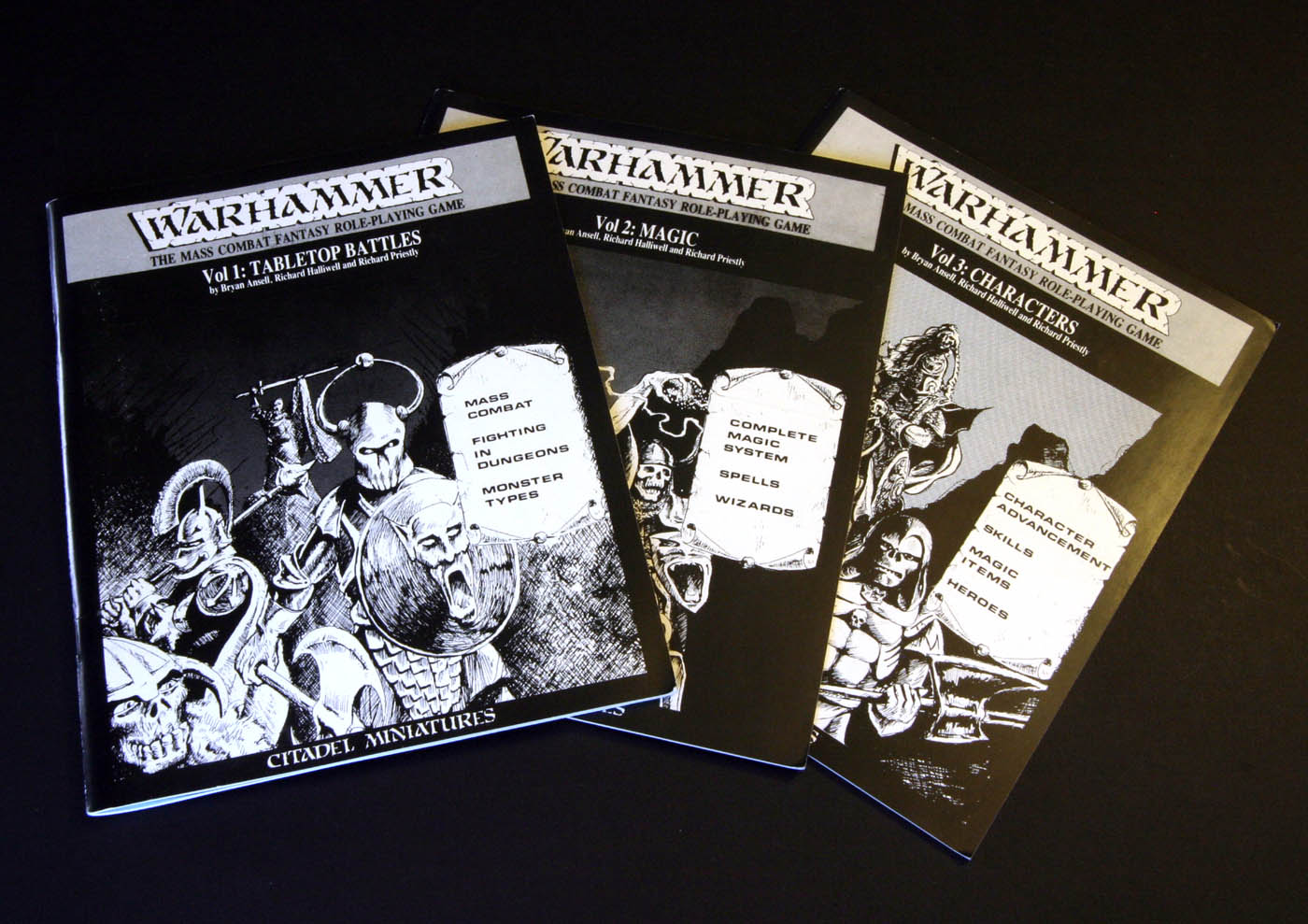
The 1st edition Warhammer rule books including character generation
However, the roleplaying concepts were not forgotten. 3rd edition Warhammer is particularly interesting. The 3rd edition rulebook was written as if it were a stand-alone system, the dedicated army list book Warhammer Armies, came later and appears to have been written to support tournament play. The basic rule book has no army lists, but it does have an extensive bestiary of fantasy creatures with points values for all of them. In addition, it includes rules and points values for a number of specialist troop types. These included Shock and Missile elites who were simply better at fighting or shooting, but also included more unusual troops like scouts, skirmishers, assassins, flagellants and berserkers. The interesting thing is that these specialist types were included as upgrades to existing troops. So if you wanted to create a goblin assassin or an elf berserker you could, and adjust the points values accordingly.
Characters were also presented as upgrades. They were given levels from 5 to 25 and these represented the number of bonuses applied to troops' profiles. The interesting thing was that these bonuses were variable, with six different options presented allowing more combat orientated or leadership orientated characters (though one was presented as the standard version to use in tournaments).

When Warhammer 40,000 was released a similar system was presented, with tables for randomly generating troops and characters and with an emphasis on scenario-based game play.
In subsequent editions, these ideas have been diluted, but elements remain. Standard Games Workshop characters are still generic types upgraded by players with equipment and/or magic items. Units vary in numbers and can frequently be upgraded with different weapon options as well as extra elements like standard bearers, musicians and champions.
This sort of approach is common for games produced independent of a range of models, such as Hordes of the Things, Armies or Arcana, Song of Blades and Heroes or Warrior Heroes: Armies and Adventurers. This is understandable as the game needs to be adaptable to players miniatures. It is more unusual for games and miniature ranges produced together.
For example in War Machine and Hordes, the number of models in a unit can vary, but not their equipment. Some can be upgraded with additional specialist models, but not all. Warjacks and Warbeasts are defined types with standard equipment. And all characters are named individuals with a defined range of abilities and equipment. The same is true of Malifaux, Helldorado, Bushido and Anima Tactics. All of them emphasise named characters with only limited, if any, upgrade options for individual troops.
Warhammer's origins as a hybrid roleplaying game has bled across into other Games Workshop games. Inquisitor, with its player-created warbands of characters has already been mentioned, but it also present in Mordheim, Necromunda and Blood Bowl. All of which feature a campaign system that emphasises gangs/warbands/teams developing over time as games are played. This system was transferred to the Warhammer Historicals Legends of the Old West and Legends of the High Seas, though the first time something like this was attempted was in Realms of Chaos.
Interestingly, it is not an approach adopted by most other Fantasy and Sci-Fi skirmish games. Bushido, Infinity, Anima Tactics, Malifaux, all of these games are of a scale similar to the Games Workshop games, but none of them have taken this route, instead opting to focus on characters created by the games designers, rather than the players.
Most of these games focus on a strongly defined game world, many with an evolving narrative. This is particularly true of Malifaux, whose narrative has developed with each rule book to the point where it seems that the writers aren't entirely sure if they're writing a rulebook or a novel. It is also true of War Machine and Hordes. In contrast, the narrative of the Warhammer world has hardly moved on in twenty five years. The game world has changed, but this has mostly consisted of retconning the existing background to fit the development of new armies. There is not a defined ongoing story.
And yet this actually fits better with the narrative approach that Games Workshop takes with its games. They present a well defined, but essentially static game world and invite players to create their own characters and develop their own narratives. The campaigns that have been built up around the Games Workshop skirmish games develop a life and a story of their own, rather than following a story defined by the game writers.
In contrast, most of the other games listed above present a strong, developing narrative and use it as a back drop. Players have essentially three choices. The first is to ignore the background and focus on the game. The narrative provides a theme to build a game and miniatures, but little more than that. This is essentially the way that card games, such as Magic the Gathering or board games work. Nobody thinks that Settlers of Catan accurately reflects the settlement of an island or Monopoly running a property empire, but it doesn't matter. The second option is to try and play within the limits of the background, much as some historical gamers prefer only to play games based around known historical events and campaigns. The third option is to develop your own background or play "what if" games that develop the official narrative in a direction of the players choosing.
What these games pointedly do not do, which most Games Workshop games do, is provide a narrative with sufficient space for players to develop their own characters and stories that still fit into the overarching story of the game world.
For some players this does not matter. Many players view wargaming as imply gaming and the narrative is of minor or no importance. But for others, developing a narrative around your characters and armies is part of the enjoyment of wargaming. And, for all the legitimate criticism aimed at it, this is one thing that Games Workshop has done well in the past and that other Sci-Fi and Fantasy games, for all their positive qualities, often neglect.
Thursday, 9 February 2012
Expand or Die
Since the announcement, via video clip, that Privateer Press would be producing 'collosal' War Jacks for War Machine, opinion has been divided over whether this is an exciting new development or a evidence of the Games Workshop-isation of the Company. Sceptical voices have been making whispers of Apocalypse.
I don't feel particularly strongly either way, I have dabbled in War Machine and Hordes, but am not a heavy collector of either. However, the announcement is interesting to me because it says something about the nature and development of Fantasy wargames over time.
For some years now Games Workshop have been locked in an endless cycle of renewal, with new editions every five years or so and the refreshing of their armies in order to keep up momentum. They release the occasional genuinely new miniature, but the bulk of them are now new versions of existing miniatures. Their current goal seems to be to re-release as much as possible in plastic.
Since Third edition, each version of Warhammer has managed to reach a state of near completeness by the time its next edition is due. Which is to say that pretty much all the miniatures and army books have been available and there has been no strict requirement for GW to produce anything more. No edition has been perfect, but then no game is. The new editions are driven now by marketing concerns, the need to have something apparently new to sell each month.
This has generally been perceived as the behaviour of a cynical, greedy company artificially creating demand while steadily inflating its prices in order to exploit its customer base. Certainly Games Workshop has behaved badly enough over the years to justify much of the hostility towards them. However, I think there is more than a touch of desperation about their current position.
Wargames are like Empires: only strong while expanding. There is a constant need for new material, rules and miniatures to retain the interest of the customer base. That isn't to say there is no interest in older models, but a company that has nothing new to offer can all too easily drift off the radar.
When a game is first starting out there is an active need for new models and rules from both companies and players, but as the game ages additional material starts to become a barrier to entry. Privateer Press's approach has been to periodically produce new rulebooks with new rules for all its factions, but that meant by the end of first edition War Machine that a player needed to buy five rule books to get all the rules for the initial four factions.
New models can be similarly problematic. The more that are produced the more the initial enthusiasts can collect, but new players are faced with increasingly more choices and experienced opponents who have much larger armies. Meanwhile, it becomes more difficult for games shops to dedicate the space to display the full range. Plus there is the difficulty of coming up with a constant stream of new ideas.
In the face of this, wargame companies have essentially three options:
After Thirty years of Warhammer and twenty five of Warhammer 40,000 Games Workshop are trapped inexorably in stage 3, with new editions every few years that add less and less each time.
At the time I started out with Games Workshop, they were just starting to reach this point. Warhammer 40,000 was still developing in new and unexpected directions, but Warhammer was stagnant. A few new Chaos models appeared, but, essentially, the game and miniature range was complete. For the first two years after I started, essentially nothing new appeared for Warhammer and, at least among my friends, no-one paid it any attention to it at all. Then fourth edition appeared and interest picked up. Suddenly all my friends were collecting Warhammer armies, and every new army book prompted some-one to start a new army. Given the results it's hardly surprising GW have repeated the tactic.
I find the situation with Privateer Press intriguing because they have clearly tried option 3 recently with the new editions of War Machine and Hordes. but thanks to prompt and rapid army book releases have found themselves quite quickly back where they started. Now they seem to be trying tactic 1, keep producing new and exciting models and hope that new players are intrigued and not overwhelmed.
I am not making any judgement about either company, but it is fascinating to me that ultimately all successful wargames must end up in the same place.
I don't feel particularly strongly either way, I have dabbled in War Machine and Hordes, but am not a heavy collector of either. However, the announcement is interesting to me because it says something about the nature and development of Fantasy wargames over time.
For some years now Games Workshop have been locked in an endless cycle of renewal, with new editions every five years or so and the refreshing of their armies in order to keep up momentum. They release the occasional genuinely new miniature, but the bulk of them are now new versions of existing miniatures. Their current goal seems to be to re-release as much as possible in plastic.
Since Third edition, each version of Warhammer has managed to reach a state of near completeness by the time its next edition is due. Which is to say that pretty much all the miniatures and army books have been available and there has been no strict requirement for GW to produce anything more. No edition has been perfect, but then no game is. The new editions are driven now by marketing concerns, the need to have something apparently new to sell each month.
This has generally been perceived as the behaviour of a cynical, greedy company artificially creating demand while steadily inflating its prices in order to exploit its customer base. Certainly Games Workshop has behaved badly enough over the years to justify much of the hostility towards them. However, I think there is more than a touch of desperation about their current position.
Wargames are like Empires: only strong while expanding. There is a constant need for new material, rules and miniatures to retain the interest of the customer base. That isn't to say there is no interest in older models, but a company that has nothing new to offer can all too easily drift off the radar.
When a game is first starting out there is an active need for new models and rules from both companies and players, but as the game ages additional material starts to become a barrier to entry. Privateer Press's approach has been to periodically produce new rulebooks with new rules for all its factions, but that meant by the end of first edition War Machine that a player needed to buy five rule books to get all the rules for the initial four factions.
New models can be similarly problematic. The more that are produced the more the initial enthusiasts can collect, but new players are faced with increasingly more choices and experienced opponents who have much larger armies. Meanwhile, it becomes more difficult for games shops to dedicate the space to display the full range. Plus there is the difficulty of coming up with a constant stream of new ideas.
In the face of this, wargame companies have essentially three options:
- Soldier on regardless, producing more and rules and models and risk putting off potential new players.
- Sweep everything clean, starting over or focusing on a new game, and alienate existing player.
- Something of a fudge, release a new edition tweaking some of the rules problems that have been discovered and produce new, hopefully better, versions of existing models.
After Thirty years of Warhammer and twenty five of Warhammer 40,000 Games Workshop are trapped inexorably in stage 3, with new editions every few years that add less and less each time.
At the time I started out with Games Workshop, they were just starting to reach this point. Warhammer 40,000 was still developing in new and unexpected directions, but Warhammer was stagnant. A few new Chaos models appeared, but, essentially, the game and miniature range was complete. For the first two years after I started, essentially nothing new appeared for Warhammer and, at least among my friends, no-one paid it any attention to it at all. Then fourth edition appeared and interest picked up. Suddenly all my friends were collecting Warhammer armies, and every new army book prompted some-one to start a new army. Given the results it's hardly surprising GW have repeated the tactic.
I find the situation with Privateer Press intriguing because they have clearly tried option 3 recently with the new editions of War Machine and Hordes. but thanks to prompt and rapid army book releases have found themselves quite quickly back where they started. Now they seem to be trying tactic 1, keep producing new and exciting models and hope that new players are intrigued and not overwhelmed.
I am not making any judgement about either company, but it is fascinating to me that ultimately all successful wargames must end up in the same place.
Subscribe to:
Posts (Atom)