In my last post I mentioned that I had bought some models for Bushido, from GCT games, a fantasy skirmish game set in a version of Medieval Japan.
Although by no means its strongest attraction, one element that drew me to it was its nicely constructed starter sets. As well as containing five or six models, it also included dice, cards and, tucked away at the back, a full set of rules. GCT games had already been handing out these small-sized rule books at the event so I came away with two copies. It was quite gratifying to see a skirmish game with a complete rule book included like this and it made me think of the late Rackham and Confrontation second edition.
Confrontation was Rackham's fantasy skirmish game, which was on to its second edition by the time it really started to make waves in the UK. This was also the time I started playing. At the time, Confrontations distribution method was highly original. Each blister back or box came with cards which contained all the rules for the models. This was a novelty at the time, miniature rules on cards were still a new thing, but Rackham took it to extremes by never printing the rules for the miniatures anywhere but on the cards, there were no Army Books until Rackham made its foray into pre-painted plastic. Also each blister came bundled with a mini-rulebook. Most models included Confrontation, the basic rules for moving and fighting, but Wizards and Clerics came with Divination and Incantation, which provided rules for magic and faith, artillery included Fortification and some characters Incarnation, which gave the rules for ongoing campaigns.
The great advantage of this approach was that you could buy a few blisters of models and be confident of having all the rules you needed to play. The points values of the models were printed on the cards, which were visible through the packaging, so you could even have a good idea of how many points you were getting.
Sadly, this all came to an end when third edition was released. Although, in many respects superior to its predecessor, the rules now came in a lushly produced hard back rulebook costing £15. The rules booklets that came with the figures were relegated to starter rules.
It has always surprised me that more games don't follow the Confrontation 2nd edition approach. Starter sets, like Bushido's, are common enough, but these generally come with 'starter rule' if any at all, with the bulk of the came relegated to a large, usually hardback, book.
As far as I can see, there are two principle motivations for producing a set of game rules. One is a belief in the rules themselves. That is to say, that the writer(s) have an excellent idea for an enjoyable game, or even a particular rules mechanic, or they see an area not well catered for by existing rules and produce a set to meet that need. This seems to be the main motivation behind a lot of historical rules writing, where the rule publishers are often different from the miniature makers, but also appears to be the case for many stand alone fantasy and sci-fi rules sets.
The other motivation, is to support a range of miniatures. In this case the miniature concept comes first, and the rules exist to justify the miniatures. That isn't to say that the rules are not well thought through or simply an after thought, but it is the miniatures that drive the game. Games Workshop have been open about this for years: the purpose of the rules is to sell miniatures. But I also suspect that it is true of a number of high concept fantasy and skirmish games, such as Malifaux, Helldorado and Infinity. In the case of Anima Tactics, I know that it is a spin off of an RPG and that the principle motivation behind the game was to create a miniature game set in that world.
When looking at this second motivation, it seems to me that a rule book simply represents a barrier to entry. If your goal is to get people buying miniatures and playing with them, then you want to minimise any additional start up costs. The great advantage of the Confrontation 2nd edition approach was that you could buy a few blisters packs and get started. If you have to buy a rulebook first, then that's money you can't spend on miniatures. Warhammer now requires a rule book and an army book meaning that the start up cost, before any miniatures are put down, is close to £70. But this is less noticeable in a mass battle game, where the number of miniatures required is large and you would expect to spend some time collecting before you can play a full sized game. With some skirmish games we have ended up in the bizarre situation where you can spend as much, or even more, on the rules than the miniatures. When a significant selling point of your game is that it is quick and easy to pick up and play, why do anything to slow it down?
It's possible that there is serious money to be made in rulebooks. I'm not really sure where to find data on this, but it may be that the cost of rulebooks provides a valuable supplement to the income of miniature companies. Though I do wonder if the profit is offset by the cost of potential players who never get into the game in the first place.
Another potential justification is the need for background material. While there are some games based on existing IP, the majority of Fantasy and Sci-Fi games are set in their own unique world. If you want customers to invest in the miniatures you need them to invest in the game world. If this is your goal, then pages of flavour text and illustrations is obviously likely to be of benefit. In this scenario, if you sell the players on the rulebook, you sell them on the game.
But while players may drawn into a game by its flavour text and imagery, we often want very different things during a game. Hundreds of pages of non-rules material can be a serious pain when you just want to look up the rules. Wyrd games seem to have realised that, hence their decision to release a background free 'rules manual' half the size of their full rulebook.
This is an area where I think GCT games have been very smart with Bushido. They have kept their background material and illustrations to a minimum within the rulebook, but put a considerable amount of material on their website. There are short stories and illustrations for every faction and, so far, they have seen frequent updates. They are not the first company to do this, Mantic has been trying it for one, but they seem to be doing a better job than most.
This was one area where Confrontation 2 fell down. The Rackham website was never as extensive as it might have been and players had to turn to Cry Havoc, their quarterly magazine, for more background information. Releasing a regular magazine is beyond the resources of most game companies, but updating a website is increasingly easy. With all that in mind, I am watching GCT with interest and wondering who else may follow their lead.
Tuesday, 27 September 2011

Wednesday, 21 September 2011
Colours at Newbury Racecourse - A Show Report
Before we start, apologies for the poor quality of the pictures. I forgot to take my regular camera so these were taken with my IPhone.
Colours, hosted by Newbury and Reading Wargames Society, has been always a show that I thought was too far away and too small to be worth the effort. This only goes to show my poor geography skills as I discovered earlier this year that it was only two short train journeys away and so, with My Little Brother in tow, I set out to see what it had to offer.
Colours certainly takes place at a slightly unusual venue. Rather than the more common school hall, convention centre of leisure complex it takes place at Newbury race course. Or rather one of the substantial hospitality buildings set up to watch the races. It certainly provides ample space, but in a building designed for height and view rather. The end effect is three long and thin floors. In fact it was rather like taking a conventional hall, slicing it in three and stacking the three bits on top of one another with quite a lot of stairs in between. This still left plenty of room for games and stands, but did leave a few rather squeezed. Simple Miniature games had inadvisedly brought an extra stand up display rack which meant getting to their stall was like squeezing down a narrow alley. Atmospheric, but not very convenient.
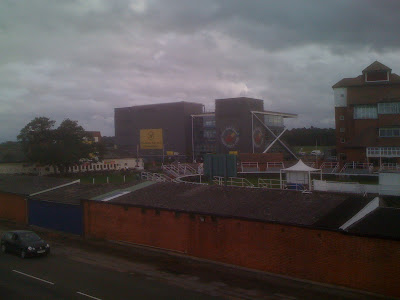 The Venue - in its rain-soaked glory
I had thought of Colours as medium-sized show, but that probably comes from comparison with Salute which is insanely massive. In fact it was quite big, with over 70 traders in attendance including plenty of familiar local faces but also a few bigger names like Warlord and West Wind. I was surprised not to see Mantic, as they had sent a stand to the much smaller Valhalla earlier in the year. But there was no shortage of their products on offer. In fact the bigger companies may have suffered on the day as they generally stick to official prices while stands all around undercut them. Why pay full price for Warlord miniatures when you can save a couple of pounds by walking to the stand next door?
The show format put the traders at bottom, working up to a level of half traders, half games and then to games, tournaments and the bring and buy, with a few exceptions for contrary traders putting on demo games, like West Wind showing off Mercs and GCT demoing Bushido (of which more below). I thought the layout worked quite well, allowing you to get your shopping out of the way before ascending a few (well quite a lot) stairs to play some games.
I went along with no fixed purchasing plans and allowed myself to get lost in the ranges on offer. GCT games and Bushido caught my eye. I had been vaguely aware of them from news items on TMP and TGN, but never paid very much attention. They were another fantasy skirmish game and I had plenty. Sadly a good display demonstrated that you can never have too many games and their fantasy take on Medieval Japan was an immediate draw. Both MLB and myself left satisfied with a starter pack each to try.
Gaming wise there was a good mix of Historical, Fantasy and Sci-Fi games and also of participation and demo games, though there seemed to be fewer quick 'pick up' games then I have seen at other shows. Many of the participation games seemed quite long runners requiring you to dedicate an hour or two of your time. Though perhaps this was more about timing and I simply missed the shorter games.
A few games caught my eye. Crooked Dice's 7TV demo looked impressive and quirky as always. 7TV uses the same basic engine as their previous Doctor Who miniature game, but with a theme based around cult TV shows and films from the 60s to the 80s, like the Avengers and James Bond at its camp height. The rules make reference to episodes and cast, rather than games and armies. It also has the advantage of needing no licence and so they can actually sell it, unlike the Doctor Who game which remains determinedly unofficial.
This set up saw a team of heroes face a villainous alliance in their lair in a dormant volcano (where else). Obviously a great deal of work had gone into the board, with the obligatory giant missile and the little yellow helicopter a particular highlight.
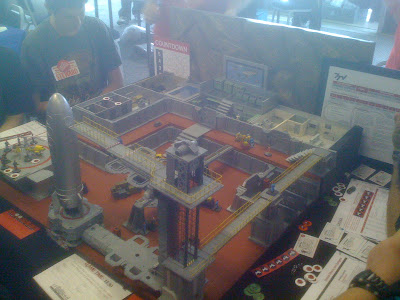 MLB and myself spent enjoyable hour with the RAF Wargames Association playing a Stargate themed games searching for missing scientists in an ancient Egyptian temple. The scenery for this came from a Playmobil set purchased on Ebay which shows that you don't need to spend ages on bespoke terrain to produce a good looking game.

A couple of other demo games stood out from the crowd. A stone age people hunting mammoths scenario by Lincombe Barn Wargames Society featured some striking mammoth models and well made fire templates. And I finally saw a game based around the opening scene of Gangs of New York by Maidenhead and District Gamers, something I have been wanting to see since I first saw the film.

On a side note, the food on offer was also slightly better than normal for a show of this size. Taking advantage of the Race course catering facilities there was a range of pasties and paninis, albeit with a long queue, and a licensed bar. Definitely a perk for some gamers, though as a non-drinker not so important for me.
Overall an enjoyable show with a good range of traders and games. My only regret being that I missed it in previous years.
Colours, hosted by Newbury and Reading Wargames Society, has been always a show that I thought was too far away and too small to be worth the effort. This only goes to show my poor geography skills as I discovered earlier this year that it was only two short train journeys away and so, with My Little Brother in tow, I set out to see what it had to offer.
Colours certainly takes place at a slightly unusual venue. Rather than the more common school hall, convention centre of leisure complex it takes place at Newbury race course. Or rather one of the substantial hospitality buildings set up to watch the races. It certainly provides ample space, but in a building designed for height and view rather. The end effect is three long and thin floors. In fact it was rather like taking a conventional hall, slicing it in three and stacking the three bits on top of one another with quite a lot of stairs in between. This still left plenty of room for games and stands, but did leave a few rather squeezed. Simple Miniature games had inadvisedly brought an extra stand up display rack which meant getting to their stall was like squeezing down a narrow alley. Atmospheric, but not very convenient.
 The Venue - in its rain-soaked glory
I had thought of Colours as medium-sized show, but that probably comes from comparison with Salute which is insanely massive. In fact it was quite big, with over 70 traders in attendance including plenty of familiar local faces but also a few bigger names like Warlord and West Wind. I was surprised not to see Mantic, as they had sent a stand to the much smaller Valhalla earlier in the year. But there was no shortage of their products on offer. In fact the bigger companies may have suffered on the day as they generally stick to official prices while stands all around undercut them. Why pay full price for Warlord miniatures when you can save a couple of pounds by walking to the stand next door?
The show format put the traders at bottom, working up to a level of half traders, half games and then to games, tournaments and the bring and buy, with a few exceptions for contrary traders putting on demo games, like West Wind showing off Mercs and GCT demoing Bushido (of which more below). I thought the layout worked quite well, allowing you to get your shopping out of the way before ascending a few (well quite a lot) stairs to play some games.
I went along with no fixed purchasing plans and allowed myself to get lost in the ranges on offer. GCT games and Bushido caught my eye. I had been vaguely aware of them from news items on TMP and TGN, but never paid very much attention. They were another fantasy skirmish game and I had plenty. Sadly a good display demonstrated that you can never have too many games and their fantasy take on Medieval Japan was an immediate draw. Both MLB and myself left satisfied with a starter pack each to try.
Gaming wise there was a good mix of Historical, Fantasy and Sci-Fi games and also of participation and demo games, though there seemed to be fewer quick 'pick up' games then I have seen at other shows. Many of the participation games seemed quite long runners requiring you to dedicate an hour or two of your time. Though perhaps this was more about timing and I simply missed the shorter games.
A few games caught my eye. Crooked Dice's 7TV demo looked impressive and quirky as always. 7TV uses the same basic engine as their previous Doctor Who miniature game, but with a theme based around cult TV shows and films from the 60s to the 80s, like the Avengers and James Bond at its camp height. The rules make reference to episodes and cast, rather than games and armies. It also has the advantage of needing no licence and so they can actually sell it, unlike the Doctor Who game which remains determinedly unofficial.
This set up saw a team of heroes face a villainous alliance in their lair in a dormant volcano (where else). Obviously a great deal of work had gone into the board, with the obligatory giant missile and the little yellow helicopter a particular highlight.
 MLB and myself spent enjoyable hour with the RAF Wargames Association playing a Stargate themed games searching for missing scientists in an ancient Egyptian temple. The scenery for this came from a Playmobil set purchased on Ebay which shows that you don't need to spend ages on bespoke terrain to produce a good looking game.
A couple of other demo games stood out from the crowd. A stone age people hunting mammoths scenario by Lincombe Barn Wargames Society featured some striking mammoth models and well made fire templates. And I finally saw a game based around the opening scene of Gangs of New York by Maidenhead and District Gamers, something I have been wanting to see since I first saw the film.

On a side note, the food on offer was also slightly better than normal for a show of this size. Taking advantage of the Race course catering facilities there was a range of pasties and paninis, albeit with a long queue, and a licensed bar. Definitely a perk for some gamers, though as a non-drinker not so important for me.
Overall an enjoyable show with a good range of traders and games. My only regret being that I missed it in previous years.
Monday, 5 September 2011
Realms of Chaos Battle Report 2 - The Battle of Bogwurst
Having gathered a band of followers, Rolf made for the village of Bogwurst. He knew that the village was weakly defended and would be an ideal place to gather supplies. But as the warband approached the village, smouldering fire and the smell of blood revealed that Rolf was not the first to have this idea. 

* * * * *
This was my second battle using the Realms of Chaos rules against My Little Brother and we were each using our second warbands. This was not a prospect to which I was greatly looking forward, largely because MLB's other warband is crazy. He managed to roll up a Level 10 Chaos Dwarf Sorcerer and decided to make him a follower of Tzeentch. This gave him a randomly generated Magic item, which turned out to be Daemon Sword (it started out as having a Daemon Prince sealed inside it but we agreed this was going a bit far and down-graded it to a Pink Horror).
So far so overpowered, but worse was to come. Tzeentchian champions get D3 chaos attributes instead of 1, and MLB rolled 3. His first two were the harmlessly ineffective big ears and black skin, but he rolled metal body for his third, giving his champion a strength and toughness of 6 and AN IMMUNITY TO NON-MAGICAL WEAPONS! His Weapon Skill and Ballistic Skill were halved but this was largely compensated for by the Daemon Sword. Given that nothing in my warband could even hurt this guy this was not going to be an easy challenge.
With all that in mind, we settled on a scenario were I had a hope of achieving something. We selected a scenario from the Realms of Chaos: the Lost and the Damned book in which the two warbands have to compete to rescue a captured cultist coven leader from a band of drunken beastmen. I didn't have the beastmen to spare, but had no shortage of plastic chaos marauders, so we decided to substitute them. We decided that the coven leader was part of the same cult as MLB's cultists and so would be a Tzeentchian.
Unsurprisingly my warband was pretty badly massacred. But thanks to taking a more direct route to my goal I managed to get the coven leader first. Had it gone the other way I wouldn't have stood a chance of getting him off MLB's warband. My Beastmen performed stirlingly, surviving a rear charge, breaking the cultists and passing a leadership test so they weren't compelled to pursue (which would have taken them in the wrong direction). To cap it all, the standard bearer passed a panic test when two of his colleagues were taken out by lightning bolts from MLB's Cultist Magus and made it into the woods.
The Orcs also did well, given they were fighting an enemy they couldn't hurt. Poor old Rolf was the real loser, taken out without a fight and not even being able to claim the Victory Points for 'Surviving the Battle on the Winning side.'
Post battle I was extraordinarily lucky. Despite losing all but two of my warband I suffered only one fatality and one injury (an Orc with a severely injured leg who I may 'retire' as he will slow down the whole unit). Even Rolf escaped unscathed, gaining his first reward and a Dragon Ogre follower. Given his impressive performance winning the day, I had to pass my follower reward onto the beastman survivor. Now I just have to get my hands on a Beast of Nurgle.
The village was abandoned, its population fled or killed. In the village square a band of drunken chaos thugs danced around a hastily constructed pyre, onto which a man in ragged robes had been tied. The Thugs danced around in a drunken frenzy. Even bound, gagged and helpless Rolf could sense the touch of chaos on their victim.
As Rolf considered his next move, a second band of chaos followers approached from the other side of the town. Five were men dressed in similar ragged robes to the sacrificial victims, five more were dwarves in armour, their leader carrying a large and ornate sword. Rolf made his decision, if this warband wanted this man, then clearly he was a prize worth taking.

Rolf ordered his warband to advance, quickly pushing past the drunken thugs who put up little resistance. From the other side, the enemy warband did the same. But as one of the thugs stumbled towards the lead dwarf he swung out his sword. As the sword touched the man there was a wailing hiss and his body shrivelled away to nothing. As if in response to his leader, one of the robed humans, who Rolf could now see had no skin on his face, stretched out a finger and let loose a bolt of lightning. Two more men collapsed in a pile of smoking ash.

Seeing that their rivals wielded magic, Rolf was daunted, but even more determined. He sent the Orcs to meet the lead dwarf, while the beastmen secured their captive. Rolf's warband reached the pyre first and the beastmen braved the flames to secure their prize. Rolf prepared himself to meet the ragged cultists, but then a second bolt of lightning leapt out and Rolf was struck down, his body crackling with energy.
With their leader fallen, the Beastmen and Orcs faltered, but the lead Beastmen, who carried Rolf's banner, bellowed a cry of defiance, hoisted his captive onto his shoulders and lead his comrades away. The Orcs braced themselves to receive the charge of the Dwarf champion. He launched himself forward his blade dancing, but the Orcs held out. However, when they struck back, they found their spear points deflected. His black skin was was harder than iron. Despite their resistance, the Orcs were slowly pushed back.

As the Beastmen retreated, the cultists saw their chance and attacked from the rear. But the beastmen disdainfully received their charge cutting down one of the cultists. Shocked by the strength of the resistance, the cultists panicked and fled. The Beastmen ignored them and marched on. The dwarves pursued, but were unable to keep pace. It seemed that Rolf's warband might claim victory after all. But then, the sorcerer hurled two more bolts of lightning and two beastmen fell. At the same time, the dwarf champion hacked through the leg of one Orc and skewered another on the point of his blade. Like the Chaos Thug before, the life was drained out of the Orc's body leaving an empty husk. Seeing the comrade subject to such a grizzly fate, the Orcs nerve gave and they fled.
The Beastman leader was not so easily bowed. Hoisting his captive he made a break for the trees at the edge of the village. Two more lightning bolts followed him, but the beastman was gone into the woods.

* * * * *
Rolf awoke to the sight of his beastman follower standing over him. It explained, in its guttural tone, that he had fled into the woods with his captive, that the rival warband had pursued but had been unable to find him. He had returned to the village and gathered up the scattered Orcs and beastmen. Despite being knocked out, the bolt of lightning had left Rolf scorched but unharmed. He gave a quiet prayer to his God for protecting him.
With his warband recovered Rolf turned his attention to his prisoner. The man was battered, but alive, but still gave Rolf a look of defiant hatred. Rolf was confused, but then he saw the twisting S shaped rune on the pendent around his neck. Somehow Rolf recognised it and hated it. Then his beastmen follower hissed a word “Tzeentch” with utter contempt and Rolf realised his prisoner was a champion of an rival God. Rolf smiled.
He tortured and killed his prisoner with sadistic glee and with a final contemptuous sneer, Rolf beheaded the man. The body fell and lay still. But then the body started to shake and convulse. Rolf stepped back as it exploded into a pile of offal and filth. Still it shook, rising up into a bloated, slug-like shape crowned by a mass of tentacles. The vile thing bounded forward toward Rolf. He backed away, but then the creature leaped towards him, licking him with its putrid Tongue like an affectionate hunting hound.
Preventing the rescue of a follower of Tzeentch was a worthy deed for a Champion of Nurgle, but to risk his life to capture and kill the champion himself had caught the attention of his God who had gifted him with one of his own Beasts. Rolf, as a champion, was quite unaffected by the creatures paralysing poisons. For his loyalty and dedication to his master his Beastman follower was rewarded with a tentacle arm like his master.
Gathering up his battered followers, Rolf made to leave Bogwurst, only to be disturbed by the lumbering arrival of a Dragon-Ogre, attracted by Sorcerer's lightning. Rolf readied himself for another fight, but the Dragon-Ogre, recognising a Chaos Champion, pledged himself to Rolf.
Casualties: 1 Orc killed, 1 serious leg injury.
Reward: Beast of Nurgle
Booty: None
Followers Reward: Chaos Attribute (Tentacle arm) for a Beastman
New Followers: 1 Dragon Ogre
* * * * *
This was my second battle using the Realms of Chaos rules against My Little Brother and we were each using our second warbands. This was not a prospect to which I was greatly looking forward, largely because MLB's other warband is crazy. He managed to roll up a Level 10 Chaos Dwarf Sorcerer and decided to make him a follower of Tzeentch. This gave him a randomly generated Magic item, which turned out to be Daemon Sword (it started out as having a Daemon Prince sealed inside it but we agreed this was going a bit far and down-graded it to a Pink Horror).
So far so overpowered, but worse was to come. Tzeentchian champions get D3 chaos attributes instead of 1, and MLB rolled 3. His first two were the harmlessly ineffective big ears and black skin, but he rolled metal body for his third, giving his champion a strength and toughness of 6 and AN IMMUNITY TO NON-MAGICAL WEAPONS! His Weapon Skill and Ballistic Skill were halved but this was largely compensated for by the Daemon Sword. Given that nothing in my warband could even hurt this guy this was not going to be an easy challenge.
With all that in mind, we settled on a scenario were I had a hope of achieving something. We selected a scenario from the Realms of Chaos: the Lost and the Damned book in which the two warbands have to compete to rescue a captured cultist coven leader from a band of drunken beastmen. I didn't have the beastmen to spare, but had no shortage of plastic chaos marauders, so we decided to substitute them. We decided that the coven leader was part of the same cult as MLB's cultists and so would be a Tzeentchian.
Unsurprisingly my warband was pretty badly massacred. But thanks to taking a more direct route to my goal I managed to get the coven leader first. Had it gone the other way I wouldn't have stood a chance of getting him off MLB's warband. My Beastmen performed stirlingly, surviving a rear charge, breaking the cultists and passing a leadership test so they weren't compelled to pursue (which would have taken them in the wrong direction). To cap it all, the standard bearer passed a panic test when two of his colleagues were taken out by lightning bolts from MLB's Cultist Magus and made it into the woods.
The Orcs also did well, given they were fighting an enemy they couldn't hurt. Poor old Rolf was the real loser, taken out without a fight and not even being able to claim the Victory Points for 'Surviving the Battle on the Winning side.'
Post battle I was extraordinarily lucky. Despite losing all but two of my warband I suffered only one fatality and one injury (an Orc with a severely injured leg who I may 'retire' as he will slow down the whole unit). Even Rolf escaped unscathed, gaining his first reward and a Dragon Ogre follower. Given his impressive performance winning the day, I had to pass my follower reward onto the beastman survivor. Now I just have to get my hands on a Beast of Nurgle.
Sunday, 4 September 2011
White Dwarf Retrospective - 133 January 1991
My second look back on old White Dwarfs takes us to January of 1991 and WD 133. The front cover this time depicts the Blood Angels, lead by a ridiculously shiny gold armoured Captain, who would go on to be the inspiration for the special characters Commander Dante and Captain Tycho. Though not as popular as 121's cover, this image did do double duty as the front cover of the Warhammer 40,000 compilation (see here).
 The overall feel of the magazine had not changed greatly in 12 months. We still have mostly two colour articles, largely focused on new rules with little over arching theme and little coverage of Warhammer Fantasy Battle. Though the exclusively rule-based articles of WD 121 have been supplemented here by a rather useful 'Modelling Workshop' article on Fences and hedge rows. Modelling workshop had been running for some months, but had been focused on larger or more elaborate projects like barns, cottages, ruined temples, etc. So an article on something more straightforward was very welcome. The end result is well illustrated and easy to follow. Definitely of use even to modern players.
 A surprisingly large proportion of the rest of the issue is devoted to the rules for Mek-boys for the Space Ork army. Since the preview in WD 121 the Orks had received a considerable amount of new material, much of which would ultimately end up in their two supplement books "'Ere we Go" and "Freebooterz". Having printed an army list, vehicle rules and rules for most basic troop types, WD had turned its attention to more and more obscure rules. Given their current role within the Ork army, basic characters with access to slightly specialised equipment, the first edition rules for the Mek boys are remarkable, both in quantity and quality.
The article provides a set of malfunction cards that the opposing player can play on the Ork army to represents the unreliability of their equipment. Each Mekboy in the Ork army provides a mekboy card that can cancel out he malfunction. On the face of it this is a fun little 'game within a game' but when you consider that several different ork troop types had similar amounts of special rules you can imagine how complex playing an Ork army could be. The second part of the rules is devoted to the Shokk Attack gun, a weapon still around today that propels snotlings through Warp Space at the enemy. The rules include two large tables used to determine what happens when Snotlings appear inside vehicles or battle suits (such as Terminators) and the amount of detail given to each entry gives a good indication of how much fun the designers must have had designing these rules. For example:
 It feels like the designers were a little out of control, creating rules that were great fun to write and read, but cumbersome to play. When you consider that Mek Boys are one small part of one army, and that other Ork units were given rules every bit as elaborate I imagine the fun would wear off quickly during an actual game. At the age of 11 I spent ages reading through the Ork rules, but rarely put them into practice in anything but the most basic way.
The next most substantial article is devoted to new metal parts for Epic Titans and serves as a good reminder of how Epic's status has declined from once being the third core game. The article had obviously been produced to coincide with the release of the new pieces, and shows that even in the early 1990s WD content could be dictated by the release of the month. That said, as marketing strategies go this is fairly half-arsed. The rules were never published anywhere else, leaving players without this issue scuppered (at least until the release of Epic 2nd edition only 8 months later).
 Showing off the new metal Titan parts. The Orks look badly outgunned.
A few quick Space Hulk missions fill up some space and provide a little more usable content, but the most unusual element, to modern eyes, are the four pages devoted to special offer armies.
Two of them are for Warhammer Fantasy armies from Marauder miniatures. Three armies are on offer, Dark Elves, Orcs and Dwarves. At the other end of the magazine, there are two pages of special offers for 1,000 point Ork armies, six in total, one for each clan. These armies vary in price from £80 at most to as little as £30. What is striking is not only the dramatic price difference between then and now, but how much larger armies seem to have gotten. The Warhammer armies are all perfectly playable at 2,000 points each, but the Orc one, for example has only four infantry units of only 20 models each (2 of which are Goblins) and four war machines. Its hard to imagine White Dwarf presenting an army that size now, let alone selling it. The Dwarf and Dark Elf armies contain units of 10 models, barely viable now, while the Ork army uses mobs of 5 Orks. Part of the increasing cost of the Games Workshop hobby is not just more expensive models but the insistence on fielding more of them, an attitude reinforced in White Dwarf which now seems to operate a minimum army size of 3,000 points.

So, after White Dwarf 121, 133 is more of the same. Lots of rules, no coherent theme and some shockingly cheap armies. But, little did I know at the time, a price rise was on the horizon, the first of many, it will be interesting to see were we go in a years time.
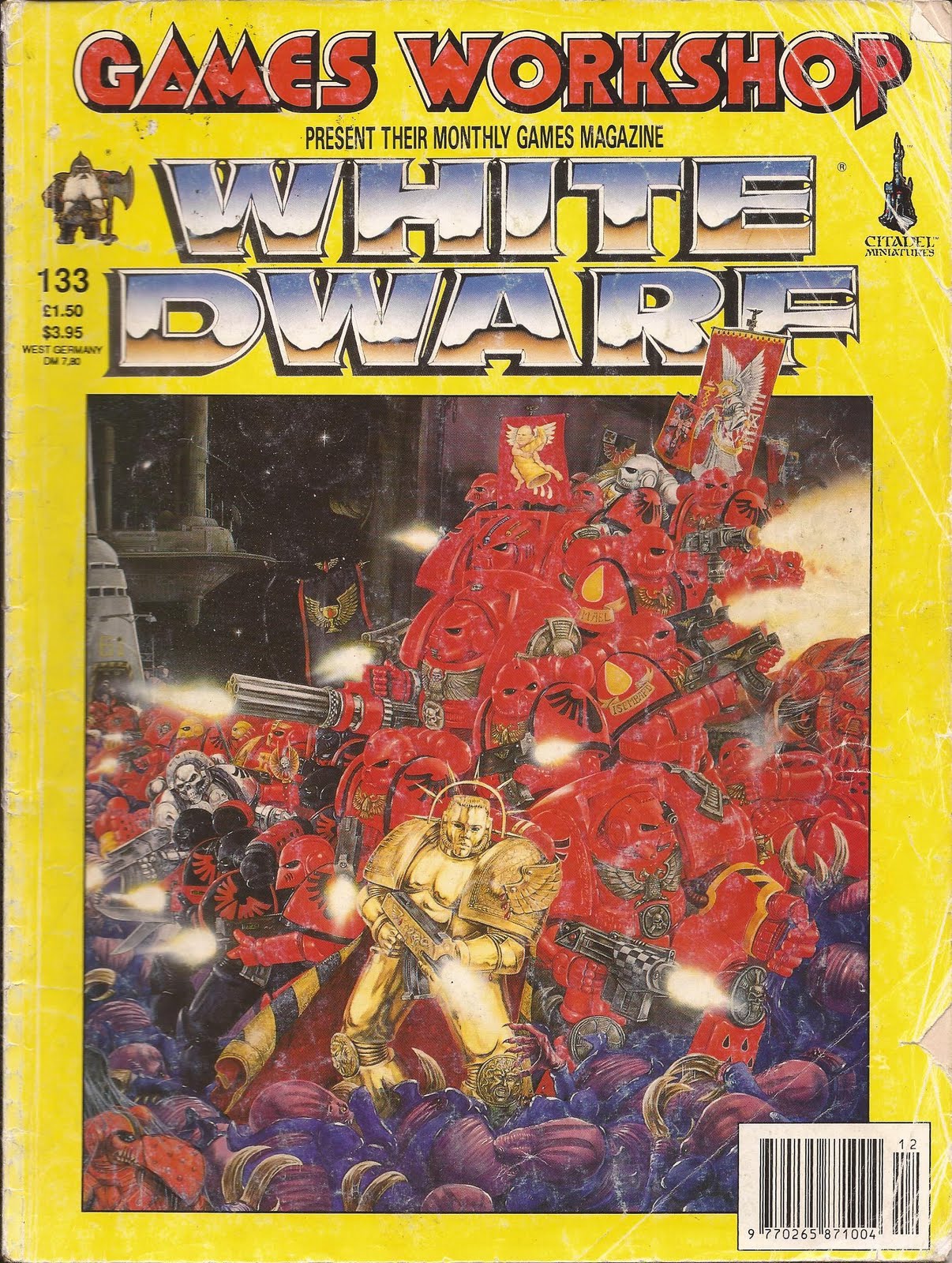 The overall feel of the magazine had not changed greatly in 12 months. We still have mostly two colour articles, largely focused on new rules with little over arching theme and little coverage of Warhammer Fantasy Battle. Though the exclusively rule-based articles of WD 121 have been supplemented here by a rather useful 'Modelling Workshop' article on Fences and hedge rows. Modelling workshop had been running for some months, but had been focused on larger or more elaborate projects like barns, cottages, ruined temples, etc. So an article on something more straightforward was very welcome. The end result is well illustrated and easy to follow. Definitely of use even to modern players.
 A surprisingly large proportion of the rest of the issue is devoted to the rules for Mek-boys for the Space Ork army. Since the preview in WD 121 the Orks had received a considerable amount of new material, much of which would ultimately end up in their two supplement books "'Ere we Go" and "Freebooterz". Having printed an army list, vehicle rules and rules for most basic troop types, WD had turned its attention to more and more obscure rules. Given their current role within the Ork army, basic characters with access to slightly specialised equipment, the first edition rules for the Mek boys are remarkable, both in quantity and quality.
The article provides a set of malfunction cards that the opposing player can play on the Ork army to represents the unreliability of their equipment. Each Mekboy in the Ork army provides a mekboy card that can cancel out he malfunction. On the face of it this is a fun little 'game within a game' but when you consider that several different ork troop types had similar amounts of special rules you can imagine how complex playing an Ork army could be. The second part of the rules is devoted to the Shokk Attack gun, a weapon still around today that propels snotlings through Warp Space at the enemy. The rules include two large tables used to determine what happens when Snotlings appear inside vehicles or battle suits (such as Terminators) and the amount of detail given to each entry gives a good indication of how much fun the designers must have had designing these rules. For example:
 It feels like the designers were a little out of control, creating rules that were great fun to write and read, but cumbersome to play. When you consider that Mek Boys are one small part of one army, and that other Ork units were given rules every bit as elaborate I imagine the fun would wear off quickly during an actual game. At the age of 11 I spent ages reading through the Ork rules, but rarely put them into practice in anything but the most basic way.
The next most substantial article is devoted to new metal parts for Epic Titans and serves as a good reminder of how Epic's status has declined from once being the third core game. The article had obviously been produced to coincide with the release of the new pieces, and shows that even in the early 1990s WD content could be dictated by the release of the month. That said, as marketing strategies go this is fairly half-arsed. The rules were never published anywhere else, leaving players without this issue scuppered (at least until the release of Epic 2nd edition only 8 months later).
 Showing off the new metal Titan parts. The Orks look badly outgunned.
A few quick Space Hulk missions fill up some space and provide a little more usable content, but the most unusual element, to modern eyes, are the four pages devoted to special offer armies.
Two of them are for Warhammer Fantasy armies from Marauder miniatures. Three armies are on offer, Dark Elves, Orcs and Dwarves. At the other end of the magazine, there are two pages of special offers for 1,000 point Ork armies, six in total, one for each clan. These armies vary in price from £80 at most to as little as £30. What is striking is not only the dramatic price difference between then and now, but how much larger armies seem to have gotten. The Warhammer armies are all perfectly playable at 2,000 points each, but the Orc one, for example has only four infantry units of only 20 models each (2 of which are Goblins) and four war machines. Its hard to imagine White Dwarf presenting an army that size now, let alone selling it. The Dwarf and Dark Elf armies contain units of 10 models, barely viable now, while the Ork army uses mobs of 5 Orks. Part of the increasing cost of the Games Workshop hobby is not just more expensive models but the insistence on fielding more of them, an attitude reinforced in White Dwarf which now seems to operate a minimum army size of 3,000 points.

So, after White Dwarf 121, 133 is more of the same. Lots of rules, no coherent theme and some shockingly cheap armies. But, little did I know at the time, a price rise was on the horizon, the first of many, it will be interesting to see were we go in a years time.
Monday, 22 August 2011
Battle of the Sarcophagus
Drawn by a source of magical power, Saargash's warband made their way through the forest until they came to a clearing. In the centre was a ruined and crumbling mausoleum decorated with Slaanesh runes and icons. Their path had been guided by Slaanesh himself. But Saargash's elation turned, exquisitely, to anger as he saw that another warband had arrived first.
 Saargash's warband, fully assembled and painted
This was the first test of the Realms of Chaos rules and my randomly generated warband and saw Saargash Champion of Slaanesh take on my little brother's decidedly eccentric Nurgle warband, lead by a Dark Elf Champion and consisting of a unit of Ghouls and a Chaos Sorcerer with the head of a Goat. I won't write about it in too much detail in case he decides to write about it on his own blog, but if he does I will add a link.
We had decided to play a scenario from the Lost and the Damned book which saw our two warbands contesting control of an ancient sarcophagus. MLB won the dice roll which put him in control of it at the start of the game. He sent his Ghouls out ahead, trying to use nearby swamps as cover. Unfortunately for him, he underestimated the reach of my Centaurs who charged and quickly sent the Ghouls scattering (they break automatically if defeated in combat).
At this point we hit some difficulty with the rules. In third edition Warhammer, fleeing units are not wiped out of caught, they just keep running with the enemy getting a free strike against them. However, it was less than clear whether both units kept running each turn or only in their own. Rather than pursue one remaining ghoul all the way across the table, I elected to take a leadership test and hold my centaurs back. However, this left them dangerously exposed in the middle of the ruined tower that housed the sarcophagus. MLB's Wizard immediately blasted one with a fireball taking him out of the game.
Although I was in the stronger position, I was concerned about losing both centaurs and was pretty sure that the Dark Elf Champion could do some serious damage to me even if I was confident of beating him. So I dropped a mystic mist on to the tower, blocking all line of sight for three turns. At this point MLB decided discretion was the better part of valour and we agreed his warband could slip away.
With the battlefield mine I could open the sarcophagus and roll on the random table to see what it contained. Unfortunately, I was immediately attacked by an Undead Chaos Champion. We randomly generated the champion, who turned out to be another Slaaneshi Sorcerer, and gave him one reward and one attribute, which ironically turned out to be skull face. Fortunately years of undeath had taken its toll and Saargash was able to take him out. This landed me a free magic weapon with two chaos properties - magic thief which absorbs the power of other weapons and swiftness which boosts initiative.
Saargash also got enough victory points to roll for his first Chaos Reward. I initially got Chaos Armour, but decided this was a bit mundane, so I refused it in favour of rolling on the Gifts of Slaanesh table .His first reward: Musk, which forces enemies to pass a Will Power test before they can attack him. Though its biggest bonus was that I wouldn't have to convert Saargash to use it. My centaurs also generated a new chaos attribute and irrational hatred, though the one hit by the fireball suffered a chest wound and lost a point of toughness. I will have to model a burn in someway. Sadly, I didn't get any new followers this time.
One aspect of this style of campaign gaming is how much more you worry about losing models. I have been playing one off games for so long that the thought of preserving my troops for future battles didn't occur. In retrospect, I was foolish to leave my centaurs so exposed. On the other hand, MLB was seriously lucky in that none of his Ghouls suffered any permanent injuries.
Saargash beheld the strange site of a Dark Elf warrior bearing the rune of Nurgle.
“Back away,” the Champion called out. “We have no quarrel, but this find is ours.”
“Slaanesh protects and rewards his own,” Saargash called back.
“So be it,” was the Dark Elf's response.
A pack of ghouls crawled out from the Temple. Bellowing a challenge, Saargash's brothers charged forward, cutting down ghouls left and right. The ghouls were easily defeated and scattered, capering back into the Temple. Saargash's brothers pursued into the Temple, but before he could call them back, a goat headed sorcerer stepped out from the ruins. A ball of fire leaped from his hands, striking Saargash's brother Rahm in the chest. He fell to the ground. Skurn bellowed in anger as the Dark Elf climbed back to the ruins to face him.

Seeing his brother outnumbered and with himself and his beastmen still some distance away, Saargash used his power to call down a mystic mist, obscuring the temple. The rest of the warband rushed to the ruins, but, by the time they reached it, the Champion and Sorcerer had fled.
Saargash commanded his beastmen to open the sarcophagus and they were engulfed in a cloud of dust. Stepping out from the ruins, still clad in the tattered remains of his robes, was an undead Sorcerer of Slaanesh. It shrieked out an inhuman cry and struck at one of the beastmen, who staggered back. But they stood firm. Saargash leaped forward and struck the creature twice with his blades. It collapsed in a pile of dust and bones. As the champion collapsed, Saargash snatched up his sword, which glowed with Chaos Power.

Holding the sword aloft in triumph, Saargash smiled as Slaanesh bestowed a new reward. A musky perfume emanated from his body, binding to his will all who dared approach. Skurn and Rahm, who had not been badly hurt, were also rewarded with spears scavenged from the wreckage and new emotions: a fierce hatred of men and dwarfs.
Reward: Musk
Booty: 2 Spears, Chaos Weapon (Magic Thief and Swiftness)
Followers Reward: Chaos Attribute (Irrational hatred) for the Centaurs
New Followers: None
* * *
 Saargash's warband, fully assembled and painted
This was the first test of the Realms of Chaos rules and my randomly generated warband and saw Saargash Champion of Slaanesh take on my little brother's decidedly eccentric Nurgle warband, lead by a Dark Elf Champion and consisting of a unit of Ghouls and a Chaos Sorcerer with the head of a Goat. I won't write about it in too much detail in case he decides to write about it on his own blog, but if he does I will add a link.
We had decided to play a scenario from the Lost and the Damned book which saw our two warbands contesting control of an ancient sarcophagus. MLB won the dice roll which put him in control of it at the start of the game. He sent his Ghouls out ahead, trying to use nearby swamps as cover. Unfortunately for him, he underestimated the reach of my Centaurs who charged and quickly sent the Ghouls scattering (they break automatically if defeated in combat).
At this point we hit some difficulty with the rules. In third edition Warhammer, fleeing units are not wiped out of caught, they just keep running with the enemy getting a free strike against them. However, it was less than clear whether both units kept running each turn or only in their own. Rather than pursue one remaining ghoul all the way across the table, I elected to take a leadership test and hold my centaurs back. However, this left them dangerously exposed in the middle of the ruined tower that housed the sarcophagus. MLB's Wizard immediately blasted one with a fireball taking him out of the game.
Although I was in the stronger position, I was concerned about losing both centaurs and was pretty sure that the Dark Elf Champion could do some serious damage to me even if I was confident of beating him. So I dropped a mystic mist on to the tower, blocking all line of sight for three turns. At this point MLB decided discretion was the better part of valour and we agreed his warband could slip away.
With the battlefield mine I could open the sarcophagus and roll on the random table to see what it contained. Unfortunately, I was immediately attacked by an Undead Chaos Champion. We randomly generated the champion, who turned out to be another Slaaneshi Sorcerer, and gave him one reward and one attribute, which ironically turned out to be skull face. Fortunately years of undeath had taken its toll and Saargash was able to take him out. This landed me a free magic weapon with two chaos properties - magic thief which absorbs the power of other weapons and swiftness which boosts initiative.
Saargash also got enough victory points to roll for his first Chaos Reward. I initially got Chaos Armour, but decided this was a bit mundane, so I refused it in favour of rolling on the Gifts of Slaanesh table .His first reward: Musk, which forces enemies to pass a Will Power test before they can attack him. Though its biggest bonus was that I wouldn't have to convert Saargash to use it. My centaurs also generated a new chaos attribute and irrational hatred, though the one hit by the fireball suffered a chest wound and lost a point of toughness. I will have to model a burn in someway. Sadly, I didn't get any new followers this time.
One aspect of this style of campaign gaming is how much more you worry about losing models. I have been playing one off games for so long that the thought of preserving my troops for future battles didn't occur. In retrospect, I was foolish to leave my centaurs so exposed. On the other hand, MLB was seriously lucky in that none of his Ghouls suffered any permanent injuries.
Friday, 12 August 2011
Mantic, Games Workshop and Substitute miniatures
An editorial on Tabletop Gaming news has had me thinking. The article talks about the virtues of Mantic Games 'non-competitive' approach to wargaming, producing models than can easily be substituted for existing Games Workshop ones and allowing you to produce armies compatible with both companies games. Its a good article, but what I found fascinating was some of the comments below. Most notably:
Firstly, its worth noting that Games Workshop are not exactly slow to send out cease and desist orders when they feel their IP is being infringed. That Mantic have been left alone suggests that Games Workshop don't feel they have any kind of case on this score.
While it is probably true that most, if not all, of Mantic's releases can be substituted for similar Games Workshop ones, its worth looking at exactly what they are producing: heavy armoured dwarfs, elves with bows, Orc warriors, skeletons, zombies, ghouls, vampires. All of these are standard fantasy types, you could just as easily accuse them of ripping off Dungeons & Dragons. If they really were stealing Games Workshop's IP you would expect to see copies of their more distinctive creations. Where are the Gyrocopters? The Varghulf? The Arachnarok? The closest they get is the Abyssal Dwarfs, and that's more filling a niche that Games Workshop set up and have largely abandoned.
The supreme irony for me, though, is that producing models of standard fantasy archetypes is exactly where Games Workshop started and I regard this as very much a good thing.
Wargaming remains a niche hobby, while Fantasy and Science Fiction are very broad genres. Only the most successful and visible properties are every likely to be licensed for official wargames, which is why we have games for Lord of the Rings, Star Wars and little else. The advantage of producing a game based on archetypes, or even cliches, is that players can bring whatever they want to the game. Warhammer is a world that takes many of the high fantasy stereotypes popularised by Tolkein and developed by his imitators, and adds in gothic horror and a concept of Chaos that owes a debt to Michael Moorcock and H P Lovecraft. If you are a high fantasy fan, its not hard to take your favourite novel, comic or film and use it as inspiration for your Warhammer army.
For the most part companies seeking to carve out a niche within the niche of Fantasy Wargaming have tended to either reinterpret the archetypes (Chronopia, Confrontaion) or actively move away from them (Malifaux, Wargods, Anima Tactics). Mantic are different, in that they have decided that they can do the archetypes as well as Games Workshop or better.
That said, Games Workshop are hardly unique. Wargames Foundry, Wargames Factory, Renegade and Black Hat miniatures all have ranges of fairly traditional fantasy models, and thats just off the top of my head. The difference is that these ranges are one among many and don't have the profile of Mantic. Consequently they avoid the charge of 'ripping off' Games Workshop. Not to mention Avatars of War, which is far more explicitly aimed at Games Workshop players than are Mantic.
There's a venerable tradition in producing miniatures and games that can 'substitute' for a wide variety of source material not lucky enough to have a licensed game of its own. I am a fan of anime and manga, and there is a not insubstantial overlap between wargamers and that particular community. However, Japan has no home grown wargames industry at all, surprising when you consider the enthusiasm for model kits and miniature figures. Consequently, there are almost no licensed wargames based on Japanese IP, Privateer Press' Voltron is the only example I can think of. This has left a gap in the market for companies 'inspired' by the manga/anime aesthetic, notably Anima Tactics and Soda Pop miniatures.
Some companies have gone much further to attract the attention of gamers seeking unlicensed products - Doctor Who is a case in point. Black Tree Design still has a range based on the 'classic series' that ran between 1963 and 1996, but the only miniatures based on the recent series were produced by Character Options, who produce the Doctor Who action figures, and were clearly aimed at children. They were small and not well detailed, though plenty of gamers have gotten good mileage out of their Daleks and Cybermen. However, the free, unofficial Doctor Who miniature game remains available to download and both Heresy and Crooked Dice have a range of figures that in no way resemble the Doctor, his allies or enemies.
But the crucial question raised by the above comment is 'would we want it any other way?' I can understand why Games Workshop might have an issue with Mantic games, though they couldn't easily criticise without being accused of hypocrisy, but why would gamers? If you don't like what Mantic has to offer fine. Games Workshop products are still widely available. But surely all gamers benefit from an industry that is able to produce unlicensed substitutes for expensive or non-existent products?
Please show me one single model that they’ve produced that isn’t a direct analogue of a Games Workshop model. I don’t see Mantic making anything other than a token effort to produce a set of rules so their lawyers can point to them and say “Look – we’re not trying to horn in on Games Workshop’s IP – honest!” They’ve put no effort into producing any sort of background or context for the miniatures, and definitely haven’t come up with any new concepts of their own as far as miniature design.From Guinny. I'm going to take a look at this, not to pick on him specifically, but because it neatly reflects and attitude I've seen before and because its an interesting point of discussion. I've seen this attitude a lot, suggesting that Mantic are attempting to rip off Games Workshop and suggesting that there is something unethical or immoral in their approach.
Firstly, its worth noting that Games Workshop are not exactly slow to send out cease and desist orders when they feel their IP is being infringed. That Mantic have been left alone suggests that Games Workshop don't feel they have any kind of case on this score.
While it is probably true that most, if not all, of Mantic's releases can be substituted for similar Games Workshop ones, its worth looking at exactly what they are producing: heavy armoured dwarfs, elves with bows, Orc warriors, skeletons, zombies, ghouls, vampires. All of these are standard fantasy types, you could just as easily accuse them of ripping off Dungeons & Dragons. If they really were stealing Games Workshop's IP you would expect to see copies of their more distinctive creations. Where are the Gyrocopters? The Varghulf? The Arachnarok? The closest they get is the Abyssal Dwarfs, and that's more filling a niche that Games Workshop set up and have largely abandoned.
The supreme irony for me, though, is that producing models of standard fantasy archetypes is exactly where Games Workshop started and I regard this as very much a good thing.
Wargaming remains a niche hobby, while Fantasy and Science Fiction are very broad genres. Only the most successful and visible properties are every likely to be licensed for official wargames, which is why we have games for Lord of the Rings, Star Wars and little else. The advantage of producing a game based on archetypes, or even cliches, is that players can bring whatever they want to the game. Warhammer is a world that takes many of the high fantasy stereotypes popularised by Tolkein and developed by his imitators, and adds in gothic horror and a concept of Chaos that owes a debt to Michael Moorcock and H P Lovecraft. If you are a high fantasy fan, its not hard to take your favourite novel, comic or film and use it as inspiration for your Warhammer army.
For the most part companies seeking to carve out a niche within the niche of Fantasy Wargaming have tended to either reinterpret the archetypes (Chronopia, Confrontaion) or actively move away from them (Malifaux, Wargods, Anima Tactics). Mantic are different, in that they have decided that they can do the archetypes as well as Games Workshop or better.
That said, Games Workshop are hardly unique. Wargames Foundry, Wargames Factory, Renegade and Black Hat miniatures all have ranges of fairly traditional fantasy models, and thats just off the top of my head. The difference is that these ranges are one among many and don't have the profile of Mantic. Consequently they avoid the charge of 'ripping off' Games Workshop. Not to mention Avatars of War, which is far more explicitly aimed at Games Workshop players than are Mantic.
There's a venerable tradition in producing miniatures and games that can 'substitute' for a wide variety of source material not lucky enough to have a licensed game of its own. I am a fan of anime and manga, and there is a not insubstantial overlap between wargamers and that particular community. However, Japan has no home grown wargames industry at all, surprising when you consider the enthusiasm for model kits and miniature figures. Consequently, there are almost no licensed wargames based on Japanese IP, Privateer Press' Voltron is the only example I can think of. This has left a gap in the market for companies 'inspired' by the manga/anime aesthetic, notably Anima Tactics and Soda Pop miniatures.
Some companies have gone much further to attract the attention of gamers seeking unlicensed products - Doctor Who is a case in point. Black Tree Design still has a range based on the 'classic series' that ran between 1963 and 1996, but the only miniatures based on the recent series were produced by Character Options, who produce the Doctor Who action figures, and were clearly aimed at children. They were small and not well detailed, though plenty of gamers have gotten good mileage out of their Daleks and Cybermen. However, the free, unofficial Doctor Who miniature game remains available to download and both Heresy and Crooked Dice have a range of figures that in no way resemble the Doctor, his allies or enemies.
But the crucial question raised by the above comment is 'would we want it any other way?' I can understand why Games Workshop might have an issue with Mantic games, though they couldn't easily criticise without being accused of hypocrisy, but why would gamers? If you don't like what Mantic has to offer fine. Games Workshop products are still widely available. But surely all gamers benefit from an industry that is able to produce unlicensed substitutes for expensive or non-existent products?
Wednesday, 10 August 2011
In answer to a question...
My last post attracted a rather interesting comment from Itinerant:
I hope Itinerant will forgive me, but given that it was off topic and it raises an interesting question I thought I would attempt to give it enough space to tackle properly. The question made me think more about what makes motivates me to play certain types of games, though I'm not sure the answer will be very helpful.
For me wargaming has always been about the miniatures and the concepts first and foremost. I started out as a Games Workshop player and what attracted me to their games and miniatures was a combination of their imagery and the way that was presented in the miniatures. The Warhammer and Warhammer 40,000 universes were always strikingly visual places with a kind of dark excitement that appealed to a teenage mind.
I started out as a Warhammer 40,000 player, because my friends were. My first armies were for Warhammer 40,000. I came to Warhammer somewhat later, largely because I felt I was missing out by ignoring a whole other range of miniatures. I bought the rulebook without having even tried a game, the notion of whether or not I might like it never really entered my head.
So if asked the question "what appeals to you about this style of gaming?" the answer is nothing. Which is to say, it wasn't this style of gaming that appealed to me, it was a desire to collect, paint and use a certain style of miniature.
This has always been my approach to wargaming - Fantasy, Sci-Fi or Historical. If I see a particular miniature or a particular image that appeals to me I will buy it and build an army around it. My choice of units is based more around finding a particular miniature of concept appealing, rather than any tactical consideration. I can often find myself acquiring a large number of miniatures without thinking about how they might work on the table, because that has always been a secondary concern.
Not that this is necessarily a sensible approach. I have found myself acquiring a large number of miniatures for games I hardly play because, when I finally got round to looking at them, I found I didn't like the rules.
Strangely, I also have very little interest in miniatures that don't belong to a specific game. Although, these days, I am more a collector and painter than player I still prefer to collect armies rather than individual miniatures.
None of this is terribly helpful if you want to know the appeal of formation heavy, mass battle historical and fantasy games. So, with that in mind, I have tried to consider what it is about games like Warhammer that have kept me playing while others have fallen by the way side.
There is a simple visual appeal in seeing rank upon rank of troops lined up. Even if at 28mm scale units of miniatures are far smaller than any historical one, the effect of ranking them together in blocks serves to make them look larger and more imposing. There is a sense in which a ranked up army looks more ready to take on the world. But fundamentally, this is still an aesthetic consideration.
All I can say is that I had never drawn a sharp distinction between ranked up fantasy and ancient wargaming and modern and sci-fi wargaming. All wargaming is fundamentally about maneuvering groups of troops into the most advantageous position, attempting to bring force to bear at your opponent's weak points. Nor is it necessarily the case that modern/sci-fi gaming is more mobile. While individual troops may have more freedom of position, due to the looser formation requirements, games can bogged down in protracted fire fights in which neither side attempts to approach the other.
So I don't have a simple answer to the question. All I can say is that the differences between ancient/fantasy and modern/sci-fi wargaming have never really mattered to me and that is the appeal of miniatures and concepts that bring me to a game more than the rules.
"I've got a question that doesn't have much to do with your entry. But I couldn't find an email for you...and I suppose it's a reflection type of question. Anyway,
I've only played WWII mini gaming and a couple of Future War Commander. The whole fantasy side of things (and Samurai) fascinate me. However, I must say that I don't understand the appeal to the style of gaming. Moving big blocks of troops for optimal position, then moving together for melee (close combat, etc) and then withdraw or take ground. It seems some what stale...
I'm not quite sure and I must be wrong, because fantasy and ancient battles is pretty popular so there must be more to it.
Can you tell me what appeals to you about this style of gaming vs more mobile shooting style of modern/sci fi gaming?"
I hope Itinerant will forgive me, but given that it was off topic and it raises an interesting question I thought I would attempt to give it enough space to tackle properly. The question made me think more about what makes motivates me to play certain types of games, though I'm not sure the answer will be very helpful.
For me wargaming has always been about the miniatures and the concepts first and foremost. I started out as a Games Workshop player and what attracted me to their games and miniatures was a combination of their imagery and the way that was presented in the miniatures. The Warhammer and Warhammer 40,000 universes were always strikingly visual places with a kind of dark excitement that appealed to a teenage mind.
I started out as a Warhammer 40,000 player, because my friends were. My first armies were for Warhammer 40,000. I came to Warhammer somewhat later, largely because I felt I was missing out by ignoring a whole other range of miniatures. I bought the rulebook without having even tried a game, the notion of whether or not I might like it never really entered my head.
So if asked the question "what appeals to you about this style of gaming?" the answer is nothing. Which is to say, it wasn't this style of gaming that appealed to me, it was a desire to collect, paint and use a certain style of miniature.
This has always been my approach to wargaming - Fantasy, Sci-Fi or Historical. If I see a particular miniature or a particular image that appeals to me I will buy it and build an army around it. My choice of units is based more around finding a particular miniature of concept appealing, rather than any tactical consideration. I can often find myself acquiring a large number of miniatures without thinking about how they might work on the table, because that has always been a secondary concern.
Not that this is necessarily a sensible approach. I have found myself acquiring a large number of miniatures for games I hardly play because, when I finally got round to looking at them, I found I didn't like the rules.
Strangely, I also have very little interest in miniatures that don't belong to a specific game. Although, these days, I am more a collector and painter than player I still prefer to collect armies rather than individual miniatures.
None of this is terribly helpful if you want to know the appeal of formation heavy, mass battle historical and fantasy games. So, with that in mind, I have tried to consider what it is about games like Warhammer that have kept me playing while others have fallen by the way side.
There is a simple visual appeal in seeing rank upon rank of troops lined up. Even if at 28mm scale units of miniatures are far smaller than any historical one, the effect of ranking them together in blocks serves to make them look larger and more imposing. There is a sense in which a ranked up army looks more ready to take on the world. But fundamentally, this is still an aesthetic consideration.
All I can say is that I had never drawn a sharp distinction between ranked up fantasy and ancient wargaming and modern and sci-fi wargaming. All wargaming is fundamentally about maneuvering groups of troops into the most advantageous position, attempting to bring force to bear at your opponent's weak points. Nor is it necessarily the case that modern/sci-fi gaming is more mobile. While individual troops may have more freedom of position, due to the looser formation requirements, games can bogged down in protracted fire fights in which neither side attempts to approach the other.
So I don't have a simple answer to the question. All I can say is that the differences between ancient/fantasy and modern/sci-fi wargaming have never really mattered to me and that is the appeal of miniatures and concepts that bring me to a game more than the rules.
Subscribe to:
Posts (Atom)